

As people grow and develop, how does their faith develop with them?
This question can be answered in many ways. For now, we’ll be considering it through the work of theologian James Fowler (the biggest name in tracking faith through stages), and Spiral Dynamics,1 and a little dash of Vervaeke’s 4 kinds of knowing.
Keep in mind that while Fowler thought of these as “stages” which are mostly sequential, I think it’s also true that we can each tap-into any of them, and consider our health in each. Here’s the framework (I’ll discuss it more below):
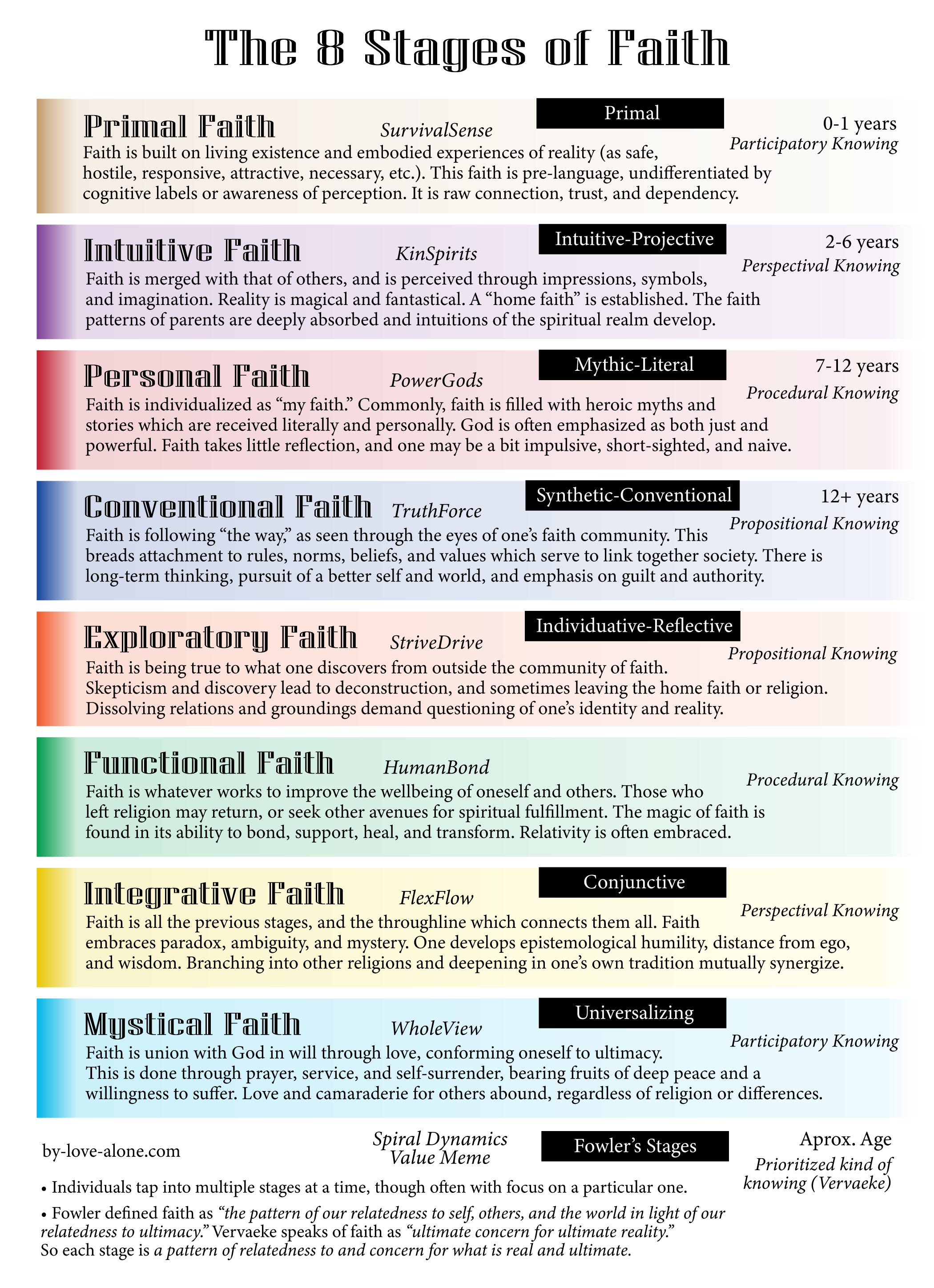
I created this chart of the 8 Stages of Faith (or 8 Patterns of Faith or 8 Dimensions of Faith) to be a fair summary of Fowler’s Stages, while also expanding his model of faith development to include the integral theory of the Spiral and to associate prioritized kinds of knowing.2
Patterns, not just stages
I believe that, consistent with Fowler and the Spiral, there is a real developmental order and ontological priority with these stages. Each one builds upon aspects of the previous, and thus they unfold naturally according to inherent patterns of reality.
Yet, I don’t believe that by “moving on” to another stage, the previous are necessarily disregarded. Nor are people at any point only in one stage, for it is quite possible for people to “move on” in one area of faith, but not another. People are able to incorporate many, even all of the stages into their faith (in fact, a robust faith should include every faith stage)! That’s because these are not just “stages” but “patterns” of faith with various focuses and underlying orientations towards what is real, transcendent, and ultimate. Thus, all the stages have indispensable value, for all connect us to aspects of what is really real.
8-Dimentional faith
Each of these patterns are also dimensions of faith — and thus, in the framing of this theory, we all have access to an 8-dimentional faith-space.
In one’s life, it may be that some dimensions are under-developed or completely unexplored. Faith may be very strong in one dimension, but if not bolstered by the other dimensions, it is brittle, and prone to breaking when stressed in the wrong way. A resilient faith is strong in many dimensions, and a vibrant faith is richly bearing fruit in at least one of the dimensions.
On Vervaeke's kinds of knowing
I am personally fascinated by the ways the 4 kinds of knowing appear to ebb and flow through these stages in a chiastic structure. (Summary of the 4 Kinds of Knowing here.)
It makes sense that Participatory knowing, the most foundational kind of knowing, frames the stages — as both primary and ultimate, in 🤎Primal Faith and 🩵Mystical Faith. Participatory knowing is the rim and center of the wheel of faith.
Perspectival knowing is the closest to Participatory. In 💜Intuitive Faith, an intuition of the patterns of reality is created through taking on different perspectives. The shaman (frequently found in “Purple religion”) is the specialist of this perspective-mining, discovering new and useful perspectives using cognitive-disruptive strategies, ritual, and divination. While 💜Intuitive Faith forms our initial perspectives, 💛Integrative Faith is about gaining facility and dexterity with them, able to intentionally move between different perspectives freely, thus optimizing opponent-processing between various intuitions of faith, while also discovering meta-perspectives which unify and support all these perspectives.
Procedural knowing is about what works. This is exactly what 💚Functional Faith is, and is a common bastion for faith after deconstructing propositional faith and finding it lacking. ❤️Personal Faith is also largely about what works, but often in a more short-sighted and self-focused way. Individually, it involves personal stories about God and experiences that are only relevant to oneself — deeply valuable personally, yet not necessarily useful for engaging with others. On a collective level (in Red religion), every tribe/nation has a personal god, and that god fights for them (who cares about everyone else!). Note that sacrifice is often emphasized at this stage as a necessary procedure of faith. This is also the pattern of faith most likely to force conversions or spread faith by the sword, for it’s a tactic that “works.”
Propositional knowing is, understandably, seen as an improvement upon many of the pitfalls of “what works,” or at least it’s seen that way in 💙Conventional Faith, which promotes moral codes for the common good, and unifies people around shared beliefs, creeds, and values. 💙Conventional Faith cares about procedural conventions as well, but will justify the procedures through propositional argument moreso than procedural effectiveness. (❤️Personal faith primarily “argues” through personal witness, testimony, and action, rather than though logical argument).
The focus on logical argument in 💙Conventional Faith leads ultimately towards 🧡Exploratory Faith, and a pursuit of truth, regardless of whether it is found in the conventional pattern or not. If one is limited to exploring ideas similar to their 💙Conventional Faith, they explore without much tension with their 💙Conventional Faith… but if they 🧡explore ideas (and activities and paradigms) which seem radically opposed to their 💙Conventional Faith, there is often heavy tension and a pressure to 🧡break from the 💙Conventional Faith. This pursuit of truth, if continually stuck in the propositional realm, will lead to despair and meaninglessness, but if the pursuit of truth involves exploration through the other kinds of knowing, faith can expand to include all the stages!
What do we mean by faith?
For the purposes of this model, faith is the pattern of one’s relatedness to and concern for what is real and ultimate. All the 8 stages are examples of such patterns. I will save a more robust discussion defining faith for another time. For now, Fowler and Vervaeke have provided us adequate language.
In the non-denominational tradition I was raised in, “faith” was generally considered as “belief in God.” While this description of faith can be technically accurate if “belief” and “God” are understood in a deep way, I have concerns that this language promotes a shallow understanding of faith. For “belief” is easily confused for mere acceptance of propositions, rather than lived participation… (see my Faith or Belief? article) and “God” is easily confused for an invisible person who’s somewhat, or entirely, dictatorial. God is much better understood along the lines of the Infinite Mystery of Ultimate Reality, the Good, True, and Beautiful, Love Itself, the underlying intelligibility of the universe (Logos), Existence Itself, the Ground of Being, the Dharma, the Tao… notwithstanding that God can (and should, I believe) also be understood as personable :)
That’s it for now. What are your thoughts on this framework for understanding faith?
A few years ago I tried mapping Fowler’s 7 stages of faith onto Spiral Dynamics, and discovered the two development models overlap elegantly! The main difference is that the Spiral has 8 stages (and thus Green and Yellow are both subsumed into Fowler’s Conjunctive Faith stage). I discuss this mapping in more detail in a paper on Fowler and the Spiral (found here).
This project was kick-started when I tried to find reference charts/diagrams online of Fowler’s Stages of Faith I came up mostly empty-handed. Thus, I decided to create my own! In the process, I discovered that (1) Fowler’s naming of stages is often quite clunky for common discussion about faith and (2) The Spiral model has a lot to offer embellishing Fowler’s work and (3) I can loop in some of Vervaeke language as well to enhance the model.