
The Dialectical Needs Model
Everything we need for a balanced life: in 3 dialectics.

What do you need to survive and thrive? Food? Shelter? Love? Harmony? Autonomy?
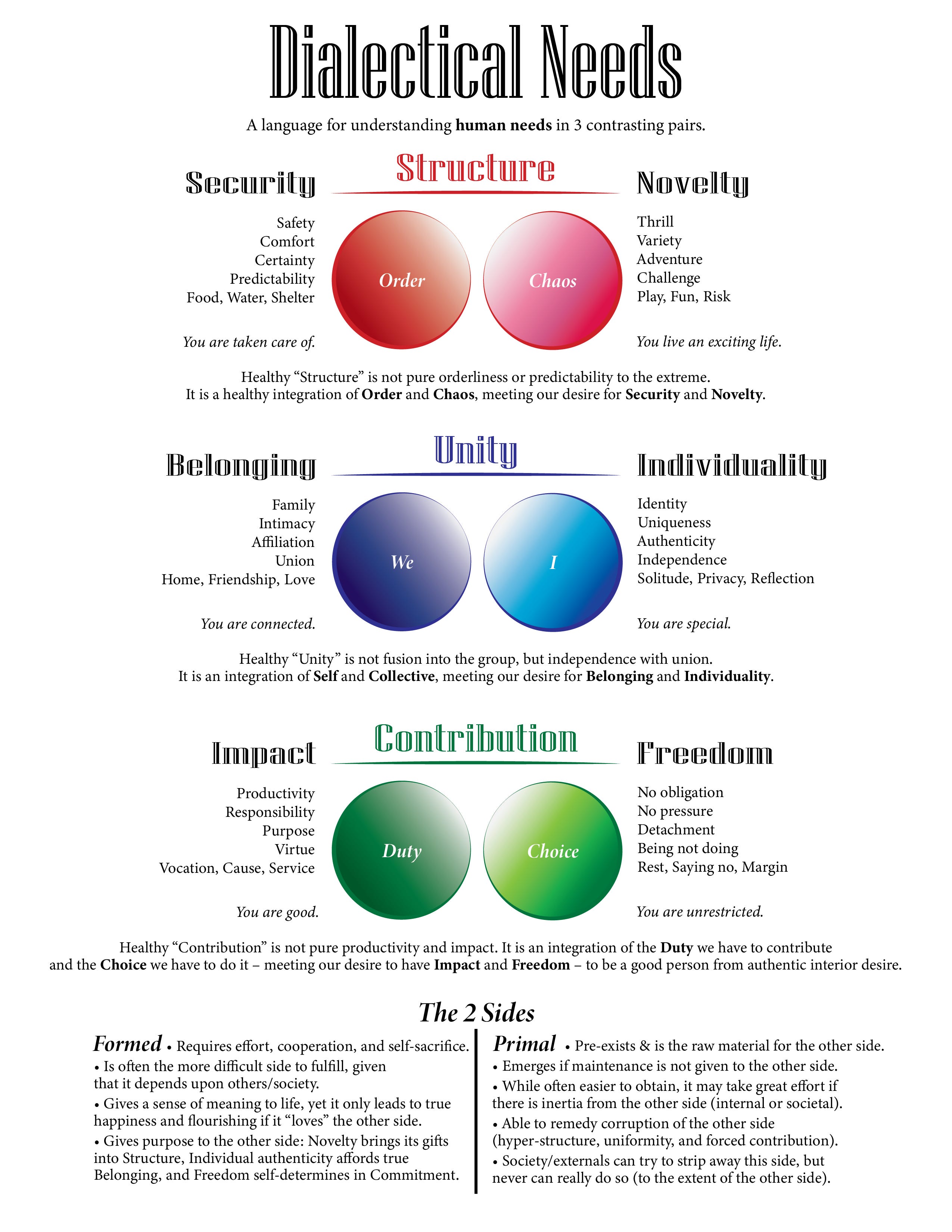
The Dialectical Needs Model is a framework for understanding all basic needs through 3 dialectics (pairs) of contrasting needs. The healthy way to meet any one need is found in the incorporation of its “opposing” need, as the truth of the dialectic is found in a “both and” integration of the sides.
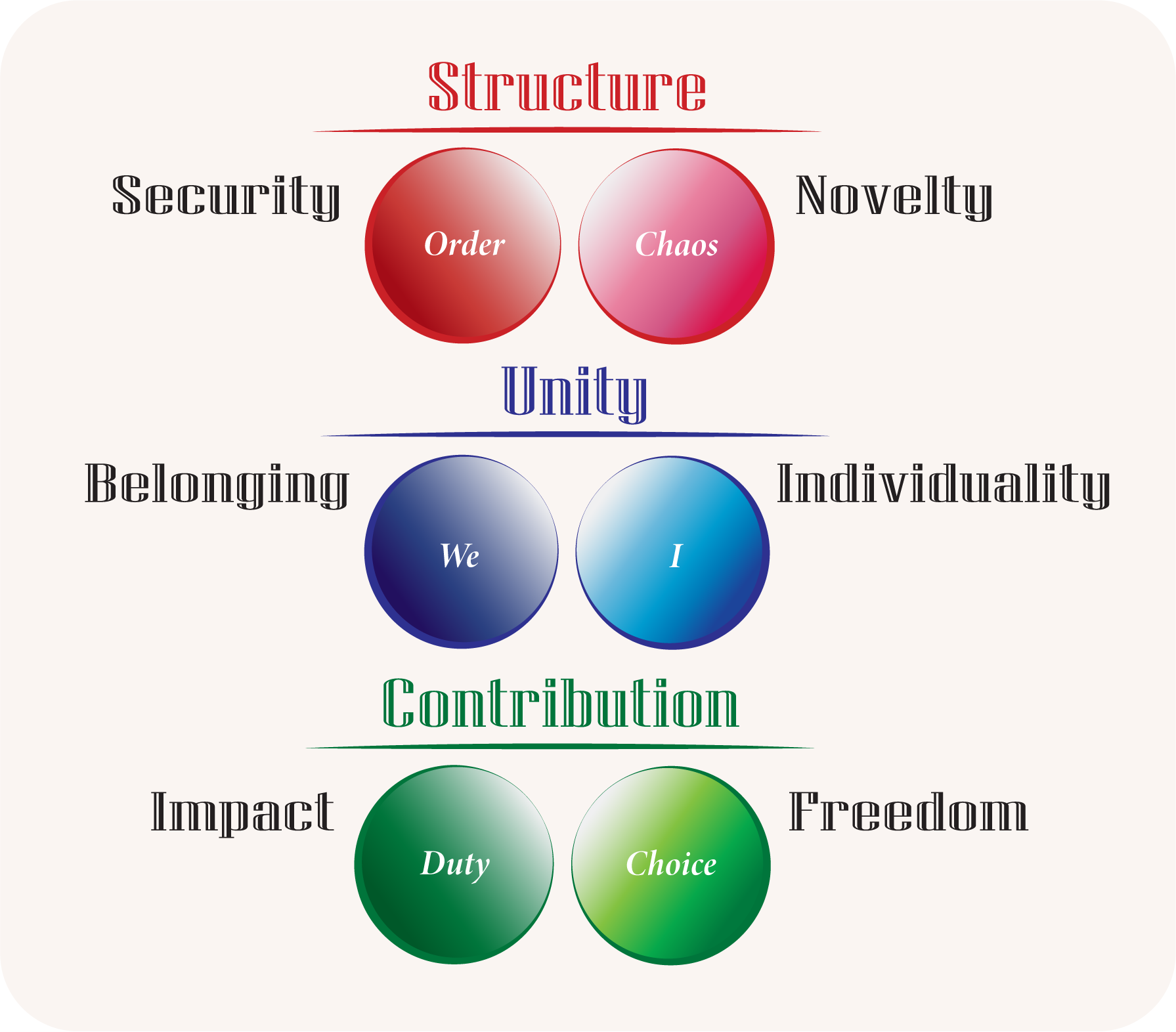
Unlike other models1 which are often limiting and not even close to comprehensive, this model has several advantages:
Opposing Needs (or Opponent Processing): Needs are sometimes in a trade-off relationship where fulfilling one one reduces the ability to fulfill the other.2
Balance (or Virtue-Mean): Every person has a fitting balance of the two sides (and the balance moves as the person or context changes).3
Dynamic (or Non-Static): Circumstances change what healthy integration of the two sides looks like.4
Individual + Collective: All individuals have all 6 needs (3 pairs). So does every society or collective. This model can be very helpful for analyzing the health of a community.
Metaphysically Grounded: Each dialectic reflects metaphysical dialectics such as the relationship between Chaos and Order and the One and the Many.
The 1st Dialectic: Security vs Novelty
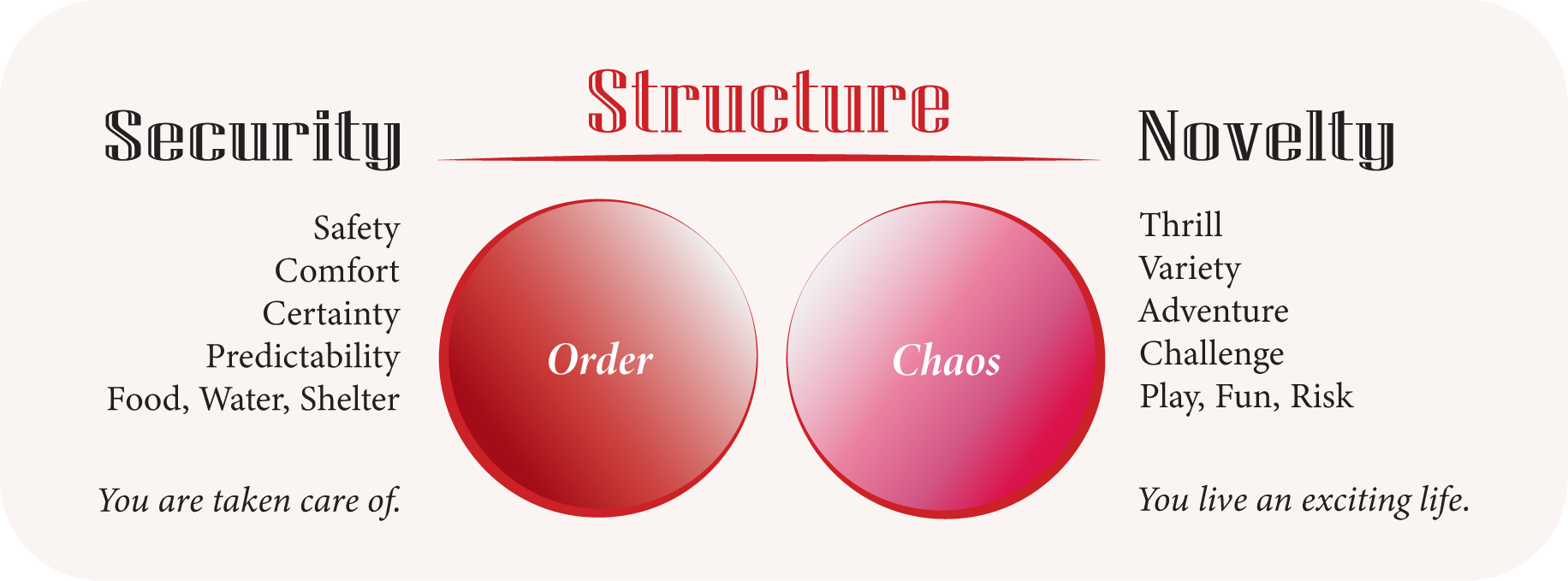
The Structure Dialectic accounts for our needs for security and novelty. I could get near-perfect security by living a predictable, mechanistic life — but I would get bored. We all want interesting things to happen… to learn new things… even to have some risk!
I cannot develop as a person without both stability and discovery. Learning and growth happens at the razor’s edge of Security and Novelty. I learn best when I’m doing a difficult task that takes all of my attention, but not so difficult that it’s overwhelming.
The 2nd Dialectic: Belonging vs Individuality
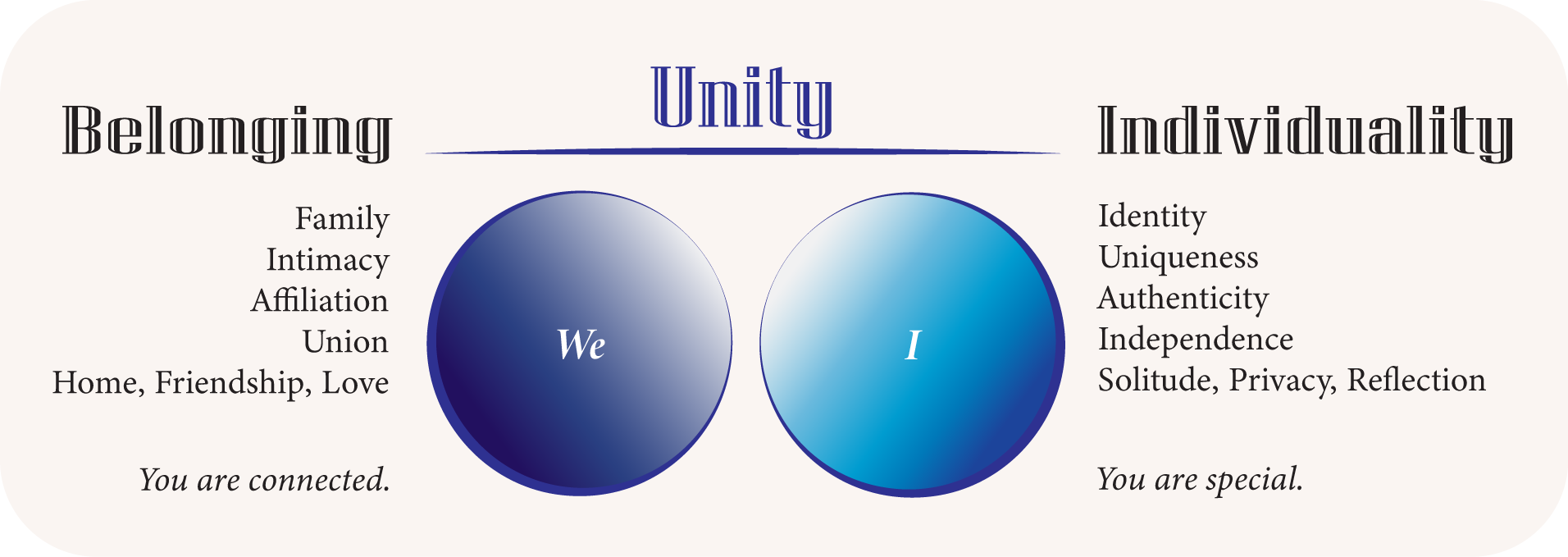
The Unity Dialectic reflects the problem of the One and the Many (which is what makes Love possible). We all have a need to Belong and feel connected with others and the world. But we also all have a need for Individuality — to be independent, special, and have an identity outside of others.
Individuality and Belonging mutually inform each other. If I have an unhealthy belonging with others (like a controlling relationship), it hinders my sense of identity and authenticity. Similarly, if I have an unhealthy view of myself (like if I’m very insecure), it hinders my ability to make friends and find belonging. This can be a downward spiral.
But also, if I have a positive sense of identity (I know who I am and am non-needy), it helps me to find and keep the right people to belong with. And if I have a really good community of people who care about me, it will help me to find my individuality.
The 3rd Dialectic: Impact vs Freedom
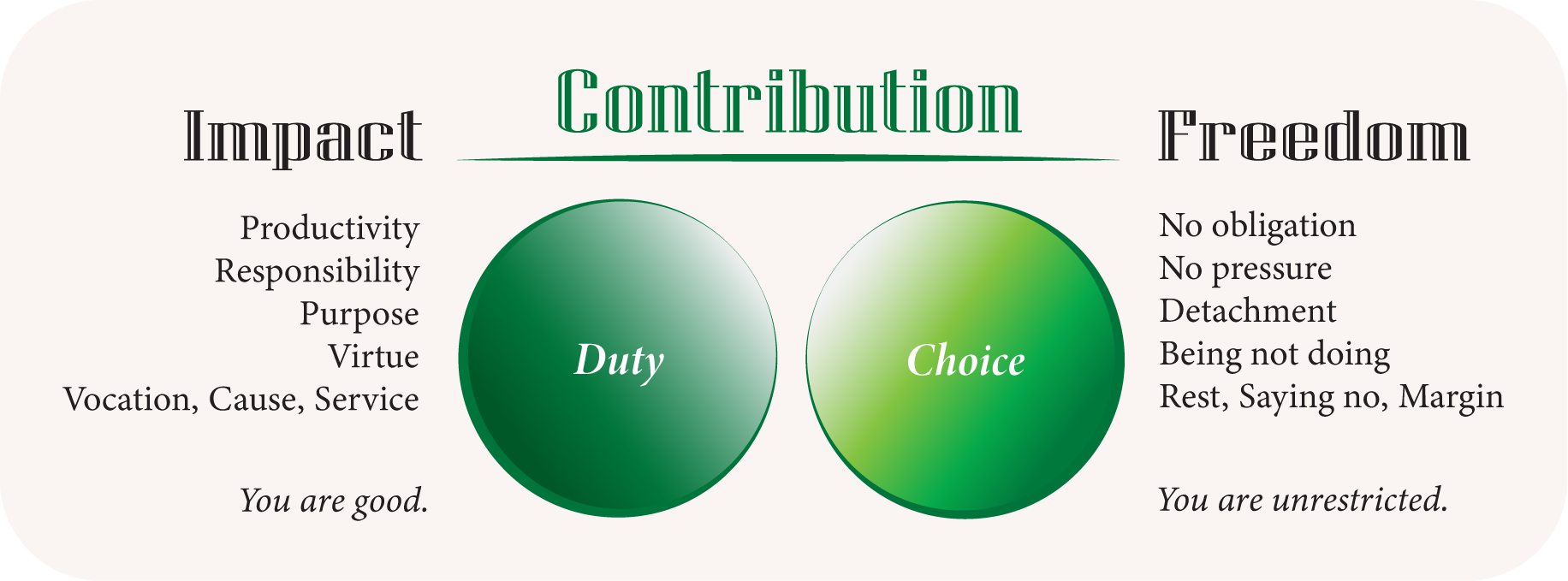
The Contribution Dialectic is based in our innate desire to be useful, to matter, to have a positive impact, and essentially, to be a good person. We have a conscience that demands things of us. Yet, if we had no choice in following these demands, we’d have no free will.5
We all have duties and responsibilities in life, yet hyper-focusing on those leads to a life drained of fun, freedom, and emotion. Many of these duties give us a sense of purpose. Typically, when someone becomes a parent, their “subjective happiness” goes down… but their sense of purpose and fulfillment goes way up! This is essentially our “need to be needed” (or at least our need to be good for something).
Yet if we’re always focused on being good for others, or being productive, we may not take time to rest… and it is from rest and Sabbath that our productive life should flow.6
Impact and Freedom depend upon each other. Goodness isn’t really good unless its freely chosen. And freedom isn’t really free unless it’s choosing the good.
2 Sides of the Same Coin
Each need has an opposite which “faces” the other way, yet both are required for the “coin” of this need to exist, and in a way, both faces are one, sharing the same substance. Yet the 2 faces are truly different.
The “Primal” faces are easier to fulfill and are more like the “raw material” for the other sides. Imagine a homeless man seeking only the Primal faces of Novelty, Individuality, and Freedom with no concern for the other sides. It would be possible for him to see himself as meeting the needs of these sides while not knowing where he will sleep the next night (he’s adventurous!), not caring not at all what others think of him (he’s authentic!), and not being a good or kind person (he doesn’t let other people or social norms rule him).
The “Formed” faces takes more work and cooperation with others. However, exclusive attention to the formed faces can be just as problematic as exclusive attention to the Primal faces. Imagine an authoritarian regime which forces conformity (belonging) dictates exactly how everyone contributes (impact) and makes sure all your basic needs are provided for in a predictable way (security). In this case, the toxic society can only heal through injections of novelty, individuality, and freedom.
The problems of one side rectified by the other.
Practical Application Questions
Which needs have I been focusing the most on?
Which needs are most lacking?
On a 1-10 scale from most-lacking to most-appropriately-met, what score would I give each of the 6 needs in my life?
Thanks for reading! I hope to continue writing about and developing this model, so any thoughts or feedback or dialogue will be valuable for me!
Maslow’s Hierarchy of needs (or goals/motivations) is the most well-known. It’s categories are: Physiological, Safety, Belonging, Esteem, Self-Actualization, and Self-Transcendence. He was onto something, but his categories are non-comprehensive (where’s the need for freedom, or variety?), and while there’s some truth to the “stacking” aspect (lower needs must be met before higher), it’s not a rigid rule and isn’t always followed.
I like the Spiral Dynamics of Needs, which identifies the most prioritized needs at every level of the Spiral: Body, Home, Autonomy, Stability, Achievement, Harmony, Self-Actualization, and Self-Transcendence. These 8 needs cover more ground than Maslow’s, and have a non-rigid, spiraling hierarchy. Yet this model doesn’t benefit from the dialectical trade-off and opponent-processing aspects of the Dialectical Needs Model.
For example, if I pick up an extra shift (helping my financial stability and impact needs), this prevents me from fulfilling my need for rest or novelty during that time.
For example, you may need a highly structured work environment while your friend needs lots of freedom.
For example, to get out of a toxic relationship, you may have to prioritize your independence above your belonging needs for a time. But later when seeking intimacy again you will need to de-prioritize your independence.
This dialectic expresses the same tension of a God who wants what’s best for everyone but also freedom for everyone (and everything).
This dialectic parallels the work-rest pendulum.
Daniel, this was a really compelling framework!!! Very well done. It struck me that each pole carries its own danger if overemphasized: the risk of order is tyranny, and the risk of chaos is instability; the risk of “we” is conformity, and the risk of “I” is isolation; the risk of duty is oppression, and the risk of choice is aimlessness. To evaluate if the both/and balance of these dialectics is integrated properly in ones life, it also helps to recognize the harms we've felt by an imbalance. Both pain and pleasure are tools to assist in our evolution.
What also intrigues me is "scaling" this. This model is true not only of an individual person, it scales and applies to larger bodies (family, community, region, culture, nation, etc). I think it is likely we may see certain dialectical needs balanced and fulfilled better within specific communities or even nations. Though proper vision for this type of evaluation does of course first require removing the log from my own eye.