

What is reality?1
What we see as “real” affects everything — our sense of meaning, our values, how we spend our time… I used to have a more restricted, rationalist perspective of reality and this flattened my sense of meaning and disenchanted my emotions. Our personal metaphysics (whether we can articulate them or not) deeply affect our lives.
So what do you see as real? Is it physical stuff? Feelings? Ideas? Perceptions? Stories? Relations? Is reality one thing or is it fragmented?
On one hand, there are materialists who posit that reality is entirely composed of matter or the physical. Within this view is the idea of bottom-up emergence: that small bits of matter can come together to form more and more complex things, including cognition, but there is not a sense of final cause nor intrinsic purpose nor a lure that matter is being drawn towards. What is most real is objectivity (truth in objects).2
On the other hand, there are idealists who posit that reality fundamentally is, or is dependent upon, consciousness, mind, or the conceptual. The analytic idealists see the substance of existence itself as being dissociative parts of a universal subjective consciousness. More generous idealisms, like Plato’s, see the immaterial possibility-space of forms and numbers as foundational, and the material world fills-out, draws-from, or participates in it. What is most real is either subjectivity (truth in subjects) or the immaterial.
There’s also a third school of thinking called process philosophy which emphasizes the relationality and becoming of all things. Becoming is more real than being. Relations more real than substances. “Verbs” more real than “nouns.” In this school of thought, the identity of “myself” can only be truly understood by all my internal relations (systems of cells) and external relations (relationship to everything else in the cosmos), whether they be material or immaterial relations. What is most real is transjectivity (truth in relations).
I propose that each of these ways of thinking can actually be correct, but only to the extent that it incorporates the other two. It seems to me that fundamentally, reality is trinitarian, which is to say it is three in one (analogous to the Divine Trinity).
Reality is (1) the objective, (2) the subjective, and (3) the transjective… it is (1) one, (2) differentiated, and (3) relational… it is (1) the nomological order, (2) the narrative order, and (3) the normative order…3
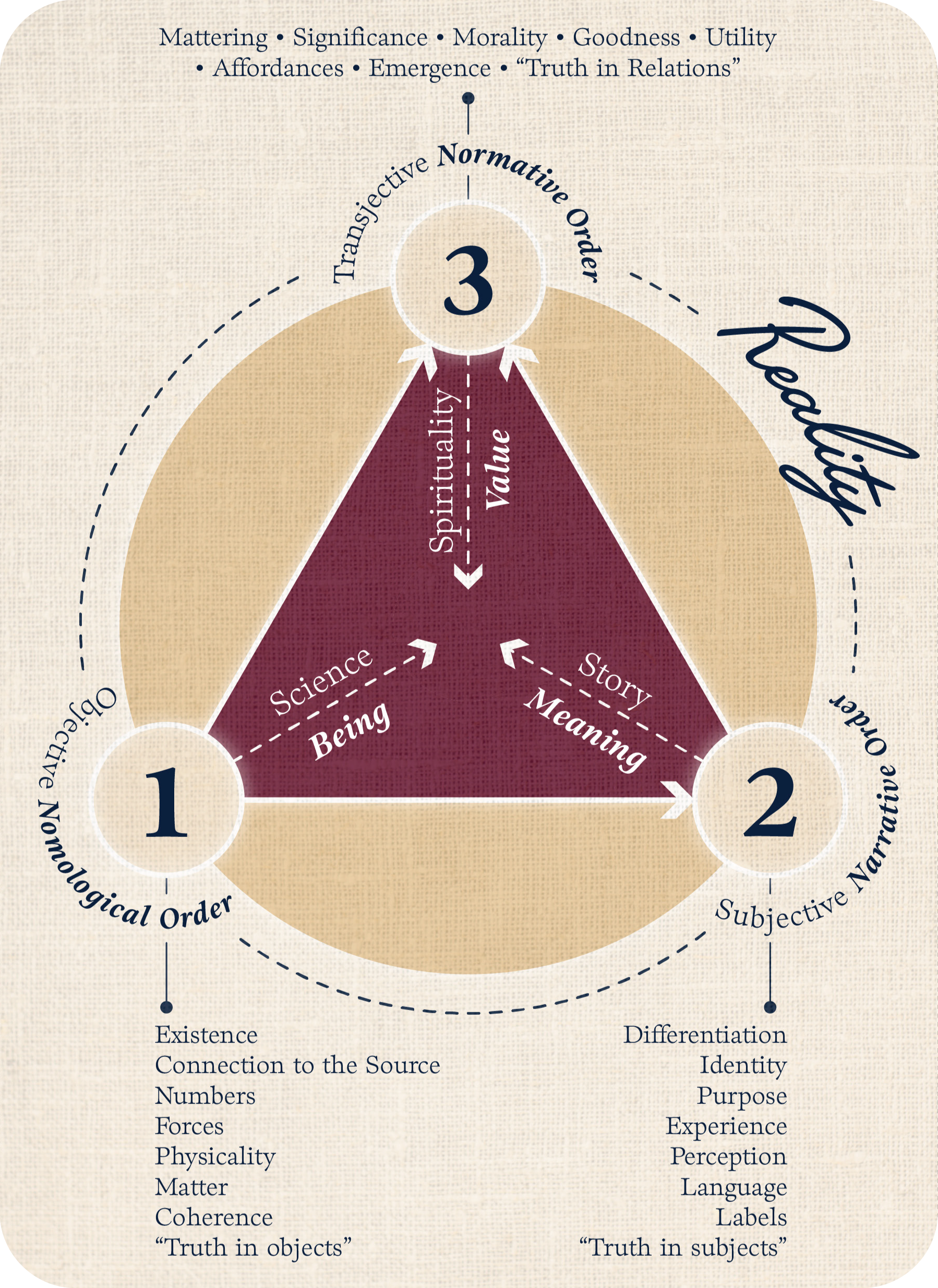
The rest of this article will explain what this diagram means and how it is analogous to the Christian understanding of the Divine Trinity.
So journey with me, into a cosmos woven with beauty and surging with creativity!
The Nomological Order (Ground of Being)
God the Father is reflected in the Nomological order of reality
— the laws (nomos/νόμος) of the universe.
These natural and consistent laws (like gravity and electromagnetism) govern the “stuff” of the universe – what we might call “objective” reality (truth within objects). One of the primary ways we study this Order is through science, which helps us to better understand how the universe “makes sense” and is coherent.
Things have Being to the extent that they participate in the Nomological Order. All things ARE because they are in and from the Ground of Being (that is, God).4
Everything is united in shared being-ness, and is an unfolding of the Is-ness (the I Am). In this way, reality is ultimately One. All things things share in the same nomos/laws, structured according to mathematics and logic, embedded within the patterns of existence itself, for they share in the same oneness.
And yet, out of the Oneness of Reality
is birthed Differentiation (different particles, different species, different people),
just as out of the Father
is birthed the Son
— who is the reflective consciousness of God,
who can witness and perceive the One.
This leads us to the Narrative Order…
The Narrative Order (Ground of Meaning)
God the Son is reflected in the Narrative order of reality
— the story of the universe.
The Son is known as the Logos (the Word) and as Divine Perception.
Words and perception both function to label and differentiate,
giving unique identity to different things.
Each identity — each piece — is able to experience and interact with the others in a dynamic narrative.
Things have Meaning to the extent that they participate in the Narrative Order. All things are seen and known and given definition and purpose within the Ground of Meaning.
The narrative of the cosmos has many differentiated “characters” (from tiny quarks to planets to humans), and each character has an experience of others, giving rise to “subjective” reality (truth within subjects). Subjective qualities are very real but are not found within objects — they are present in observers, like the quality of a sculpture being “distasteful” or of clothes being “expensive.”
We humans are given purpose through our origin/nature and generate purpose through our aims, both expressed through the stories that we tell. For example, our nature as living beings grants us the purpose of survival, and our birth into a family gifts us purpose within the family system. We tell stories of these purposes within our books, movies, and myths, and even our daily interactions where we share stories about where we’re from, what matters to us, and what we’re moving towards.
The Normative Order (Ground of Value)
God the Spirit is reflected in the Normative order of reality
— the goodness, utility, and morality of the universe.
The Normative order is the relation between the Narrative and Nomological orders. The more our stories and perceptions (Narrative) match the physical and metaphysical reality (Nomological) – which is also to say, the more that subjectivity and objectivity are in harmony – the more goodness and utility is present. A “good spirit” is present when the Nomological and the Narrative align, and goodness is attenuated in proportion to the lack of alignment between the two.
Take for example a mug which has a hole in the bottom. The physical being of the mug is out-of-alignment with the narrative purpose of the mug, and thus it is not a “good” mug, and does not afford much. We can restore the normative utility of the mug in two ways: change the objective properties by fixing the hole (in which case it affords drinking) or change the subjective properties by perceiving it instead as a flower pot (in which case it affords growing plants).
We can see that something is good because it bears fruit. Put another way: the harmony between the first two orders can be identified in that it brings about emergence, new affordances, and life!
The Relation between observer and object gives rise to what is called “transjective” reality (truth in relations). The Latin prefix trans- means across, through, or beyond, so transjectivity can also be thought of as truth across objectivity and subjectivity or truth through relationality. Transjective properties include perceptions like color (the intersection of light-waves and retina-brain interpretation) and affordances like a cup being graspable (it is only so in relation to one who can grasp it).
Thus things have Value to the extent that they participate harmoniously in the Normative order. All things matter and have moral weight because they are inherently relational, participating in the Ground of Value.
We use spirituality to develop our relationship with goodness, which gives us a sense of significance about things, and helps us become better people. For example, meditation, prayer, spiritual reading, ritual, and worship (if done well) all orient us towards the good of life – modifying our attention habits to be more effective and focused on what is good, while also enhancing our relationship with one another and with reality.
Implications
The theory I am presenting here is that Being, Meaning, and Value are all ontologically foundational, inter-penetrating, and co-emergent. There cannot be one without the other. This means simply to exist is to have intrinsic identity, meaning, orientation, purpose, worth, and goodness.
The Nomological, Narrative, and Normative orders are united with each other, yet remain distinct. In perceiving their unity, we bring back together what modernity separated, and can affirm the simultaneous necessity and inter-dependence of spirituality, story, and science. We cannot truly have one without the other.5

This foundational 3-in-1 paradox reconciles all that we currently know about the cosmos. It provides a satisfying way to understand the many different theories and philosophies that currently abound, not just about metaphysics, but about epistemology and ethics as well.
Below is a table of some of the philosophies this model brings together:
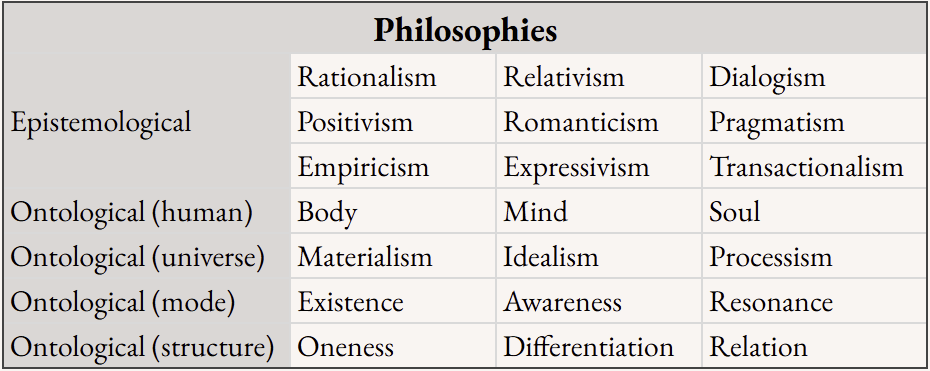
Each of these philosophies specialize in an aspect of reality and are valuable ways to approach the truth of our world. However, if one is followed in exclusion to all the others it leads us astray, for the truth of reality is found in the paradox that multiple approaches, in unity, are required for a full understanding of our world.
What is implied by “trinitarian?”
This model is inspired by the doctrines of the Trinity, which passionately and mysteriously holds the distinction of all 3 Persons of God and their unity. It affirms their co-equality and also their relational differences. It makes the claim that one is relationally first (the Father), and begets a second (the Son), and the relationship between the two is the third (the Spirit).
This perfectly describes the nature of the 3-in-1 pattern I’ve found extended through many levels of realty. Thus I call this pattern “trinitarian,” because it’s not merely triadic (in being 3) but reflects the trinitarian relations of the Godhead.
Now of course, accepting the realness of this pattern is not the same as accepting the Christian Trinity (for the Christian God involves many other aspects than simply the trinitarian features appealed to here). And accepting this general pattern does not necessitate believing it is ultimate/fundamental. For one could say it bottoms out in something else… though this still pushes the question of why these 3 categories exist, and does not explain why there are excellent arguments for the necessary and ultimacy of each.
Now, I’ll admit this model can be difficult (if not impossible) to fully grasp. It requires dialectical thinking and Yellow acceptance of paradox. Though because of this it (thankfully) is resistant to being totalized or simplified into ideology.
I’m drawn to this paradox… it feels right… it feels like love.
It means truth is fully relational, fully personal, and fully absolute :)
Thanks for bearing with me through this article to the end! I’m continuing to do work on this model and will write about it more in the future. I’d love to hear your thoughts!
Really! How would you answer this question?
The reductionist materialist views do a poor job of accounting for immaterial things like:
1. Laws that appear to govern the universe, like gravity.
2. Numbers and mathematical truths, which appear necessary, abstract, eternal, and discovered (rather than just invented or described).
3. Consciousness.
I am expanding upon the 3 orders as described by John Vervaeke (ep19 AftMC).
Nomological order: workings of the cosmos
Narrative order: story of the cosmos
Normative order: how to better align with the cosmos and account for good/evil
Vervaeke describes how these 3 orders have been pulled-apart by modernity, but used to be united as a sacred canopy of meaning: In the Western world, the nomological coherence of Aristotle and normative self-transcendence of Plotinus were brought together by Augustine into the Christian narrative of God’s love.
“Nothing has its actuality entirely in itself… but must always receive itself from beyond itself… Nothing within the cosmos contains the ground of its own being.” -David Bentley Hart (The Experience of God)
How so? Science is only done within the context of a story which says that as a society we value “discovery” and “truth” and “objectivity.” Modern science was largely inspired by the powerful mythos of alchemy and monotheistic religious narratives which taught about the intentional order of the universe, linear time, and a personable ultimate reality. The (spiritual) sense that science can lead to true moral good and human betterment is foundational to its practice, and science informs what we see as good.
Story only makes sense if it has “believability,” coherence, and the following of a nomological order, and story is an expression of a hierarchy of (spiritual) values. And spiritual practices inspire new narratives, through personal re-framing and collective inspiration and preservation of sacred texts.
And spirituality is embedded within social narrative (and personal narrative) and both inspires and is informed by science. This was true even in ancient times, in how the nomological understanding of the cosmos — like how the stars moved — greatly affected spirituality.
Very deep and introspective article Daniel. It took me a little longer to read than normal literature because of the heaviness of the subject!
I see a different perspective of the Spirit in your article than what I have come to understand through my limited Christian philosophy exposure. I grew up around the hindu culture which I later understood it to be Sanatana Dharma. Sanatana Dharma's philosophy is that we are on a continuous upward journey towards establishing a loving relationship with God.
Coming from the Sanatana Dharma perspective/background, the definition of the Spirit is two fold - the Supersoul (Paramatma) and
- the Soul (Atma).
The Supersoul is an extension/expansion of the Supreme Godhead and the Soul is the living entity (you, me and all other living creatures in this cosmos, not just humans). The Supersoul is always accompanying you, the Soul, life after life, guiding you in fulfilling your desires. The Supersoul is waiting for you, the Soul, to look towards Him and establish a Loving Relationship with Him. However, the souls/living entities are too busy in fulfilling their own desires than to look towards the Father (God). We are like a little kid in a candy store, too distracted to look towards its father. Yet, the Supersoul is patiently and lovingly waiting for the Soul to begin that true loving relationship.
All of the concepts that you discussed in the article, I see in the Sanatana Dharma philosophy as well - Purpose / Our connection with this cosmos and God / Our perception based on our inclination towards matter or spirit and so on.
Thank you for the wonderful article and contemplation. These make all of us contemplate/explore/inspire/grow.
Thank you for your explanation. I appreciate the way you describe the Father as the source of the natural and consistent order that governs objective reality, and how science helps us understand that order. One question that comes to mind, though, is how you would understand Jesus' miracles, and especially the resurrection, within this framework. If the Father is identified so closely with the consistent laws of nature, then miracles seem, at least from our ordinary perspective, to involve events that transcend or suspend those laws. Do you see miracles as genuine exceptions to the natural order, as manifestations of a deeper order that science cannot access, or in some other way?