
3 (ג): Heaven and Divinity
The symbolism of 3. Mountains, Transcendence, Non-Duality, Dialectics, Love, Relationship.

Ah, 3! What a beautiful number! It’s a very well-loved number (generally coming in 2nd place as the most common favorite number).1
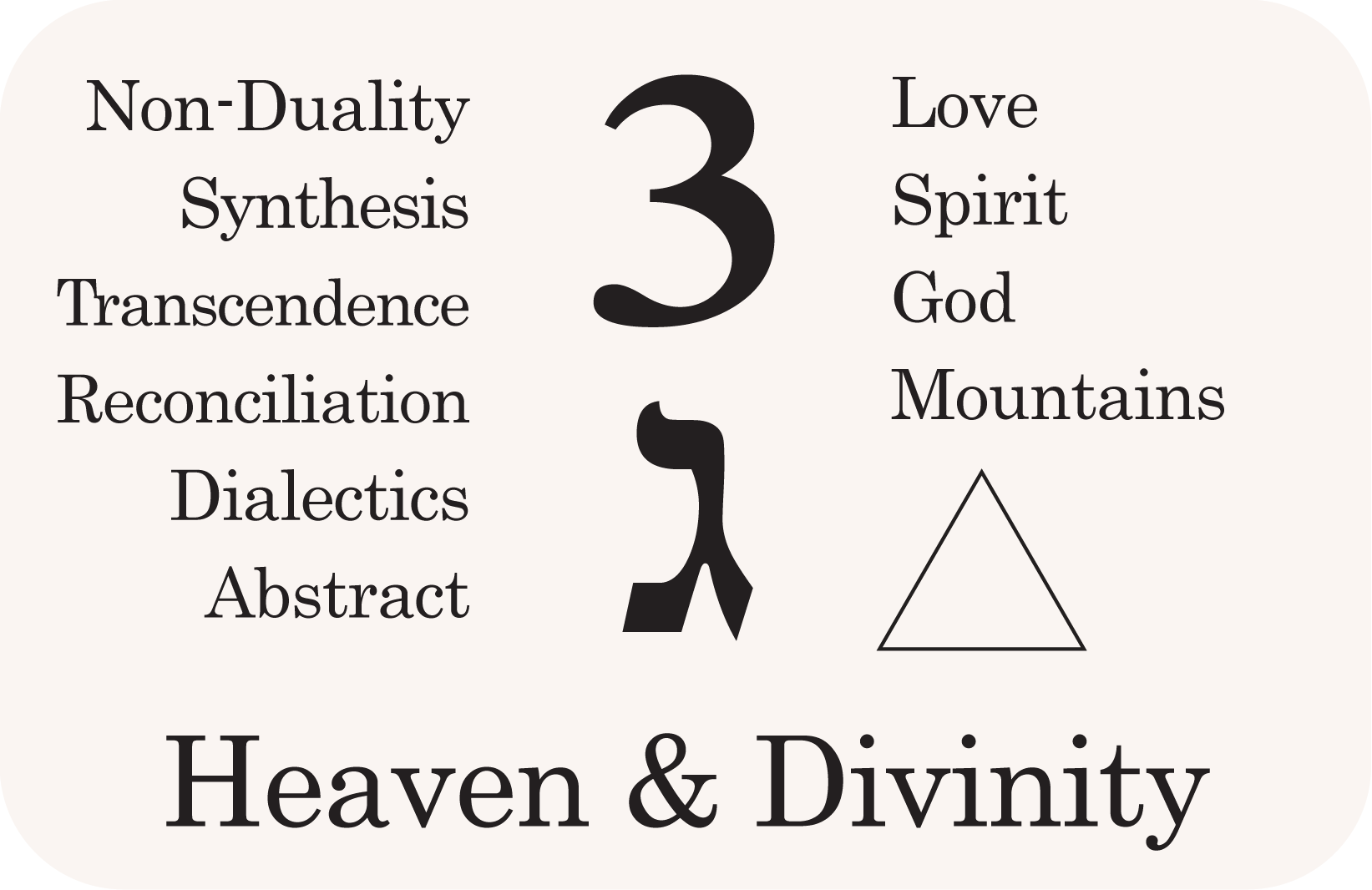
Centers and Mountains
There are many reasons people love the number 3, but I propose a strong factor is its beauty as “the first number with a center.” If we have 3 objects in a row, the two on either side frame the center (i I i). We naturally like this sort of center-symmetry.
When drawing a triangle, we particularly like triangles with center-symmetry, and ones which “point up,” so that they can rest on a flat base. A mountain is one of the greatest examples of a triangular shape in the natural world. The two bottom points of a mountain lead to the middle point at the top, lifting our gaze to the heavens.
In the ancient world, where do you go to encounter God’s presence? Atop the mountains! In the Bible, the most notable of these mountains is Saini, where God appeared to Moses and the Israelites in wind, fire, thunder, cloud, and smoke, giving them the Torah.
“On the third new moon after the Israelites had gone out of the land of Egypt, on that very day, they came into the wilderness of Sinai…
The Lord said to Moses, “Go to the people and consecrate them today and tomorrow. Have them wash their clothes and prepare for the third day, because on the third day the Lord will come down upon Mount Sinai in the sight of all the people…
On the morning of the third day there was thunder and lightning, as well as a thick cloud on the mountain and a blast of a trumpet so loud that all the people who were in the camp trembled.”—Exodus 19:1, 10-11, 16
The Bible is full of sacred mountains where God is revealed… Saini, Moriah, Carmel, Zion, Tabor, the mount of Olives. And mountains (and also 3-ness) is strongly cross-culturally associated with divinity and the heavens. Mount Kailash (Tibet), Mount Olympus (Greece), Mount Fuji (Japan), and many others. The mountain is the closest to ha-shamayim (the heavens) we can get on this earth.
Three is thus considered a divine number, representing heavenly or spiritual things.
Other notable Biblical threes include Abraham, Isaac, and Jacob; Peter, James, and John; and the 3 layers of the tabernacle (outer court, holy place, and holy of holies). All of these are human or earthly 3s, yet are 3s which are supposed to be the nearest experience of and revelation of God we have, aside from God himself.
The Torah, or technically, the TaNaKh, is divided into 3 parts: Pentateuch, Prophets, and Writings. The Christian Bible is divided into Old Testament, Gospels, and Epistles.
Synthesis and Dialectics
3 is also a number of synthesis and reconciliation. The world is filled with dialectics — two opposites and a relationship (3rd thing) between them. There’s light and dark, left and right, good and evil, freedom (free will) and fate (determinism), work and rest, sacred and mundane, belonging and individuality, unity and diversity. In all these cases, the two generate a 3rd thing — the relationship between the two — which is where we live.
In the Enneagram, the “Triangle of Possibility” teaches about non-duality and expansive thinking — type 6 is the “yes,” type 3 is the “no,” and type 9 is the 3rd option, the reconciling number. Whenever you feel stuck between a binary, this shape reminds you there is always another option.
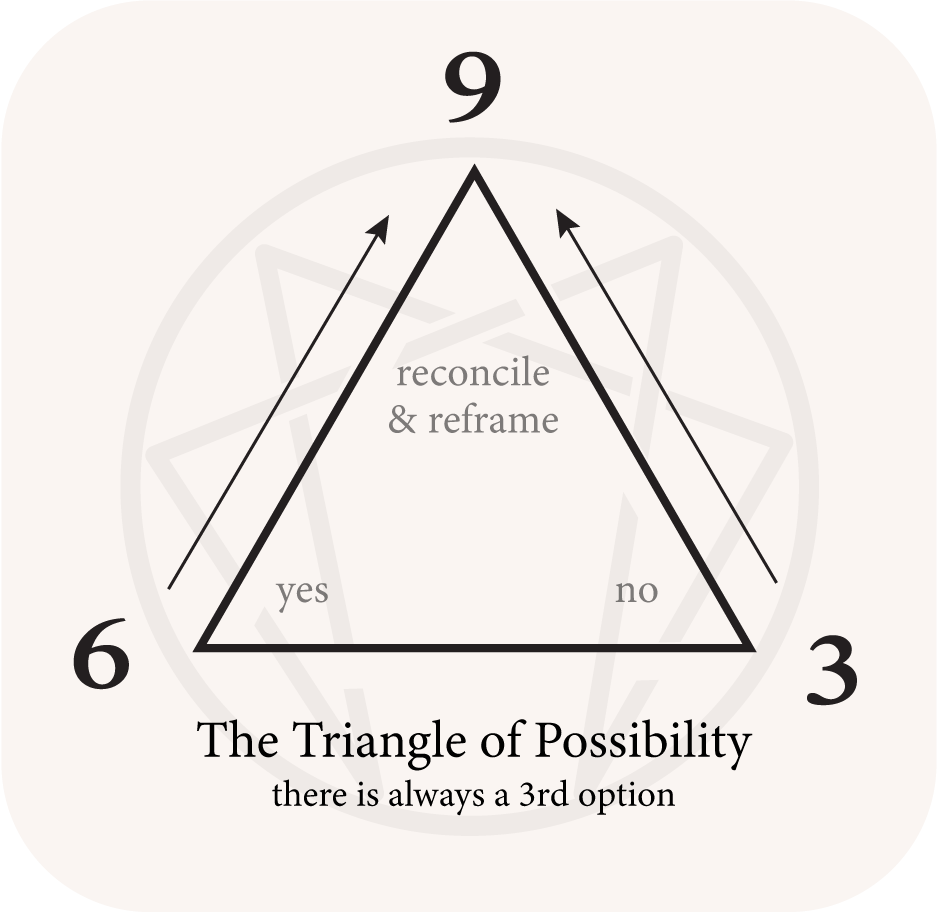
This “3rd thing” that exists between poles can be conceptualized as a synthesis and/or a transcendence,2 where synthesis is the bringing together and integration of the two poles, and transcendence is how this integration is actually more than the sum of its parts, and something qualitatively different than either of the two poles. This is the difference between mere addition (1 + 1 = 2) and the synergy of 1 + 1 = 3.
This is not the earthly logic but divine transcendence. Living in the in-between is a kind of paradox which transcends our attempts to reduce it into a binary dualism we can understand. Only God can see from the fullness of this 3rd perspective.
Divine Trinity and Spirit
Speaking of God, 3 is obviously a very Christian number for God, given that God is Triune. And there’s specifically a strong association with the Spirit of God, as the 3rd Person of the Trinity.
Thus, 3 picks up the flavor of the Spirit’s primary associations (see my Theology of the Holy Spirit paper), including movement, mystery, inspiration, wisdom, life, and relationship. 3 symbolizes the wise and life-giving navigation of the mystery of relationship.
One of the most well-known 3s of the Christian faith is Christ’s “3 days in the tomb.”3 These three days are symbolic of the divine work of God, which is an alchemical transformation of death and sin into life and freedom, and leads to the transcendence of the life-death binary through resurrection into a glorified body.
Gimel (ג) and Greatness
In Hebrew, ג (gimel) is the letter for 3. The first time this character appears in the Bible is on the 4th day when “God made the two great lights,” (הַמְּאֹרֹת הַגְּדֹלִים) in the world gadol (גדל), “great.” And gadol is indeed a great word, for its letters are (ג+ד+ל) or 3+4+30, which equals 37!4 A truly beautiful number of both divinity and perfection. The gematria of gadol teaches that true greatness is the union of heaven (3) and earth (4) — of spirit (3) and matter (4) — of mind (3) and body (4) — when undergirded by, or leading to, the divine will (30), the transcendent non-duality (30), the relationship of love (30).
The rabbis say that the shape of gimel looks like a man running. And gimel is running to the next letter in the alphabet, dalet (ד), which looks like a hunched-over man, perhaps a beggar. Thus, gimel’s greatness is in running to this man to give him charity.
Love and Relationship
This brings us to the association of 3 with love itself. Whether it’s gimel running to show love, the Spirit as the Love between the Father and the Son, or simply the association with divinity, paired with the belief that “God is love,” 3 is a number of true, relational love.
3 is the minimum number for love. For love requires a lover (giver) and a beloved (receiver), and the gift of love itself (relationship).
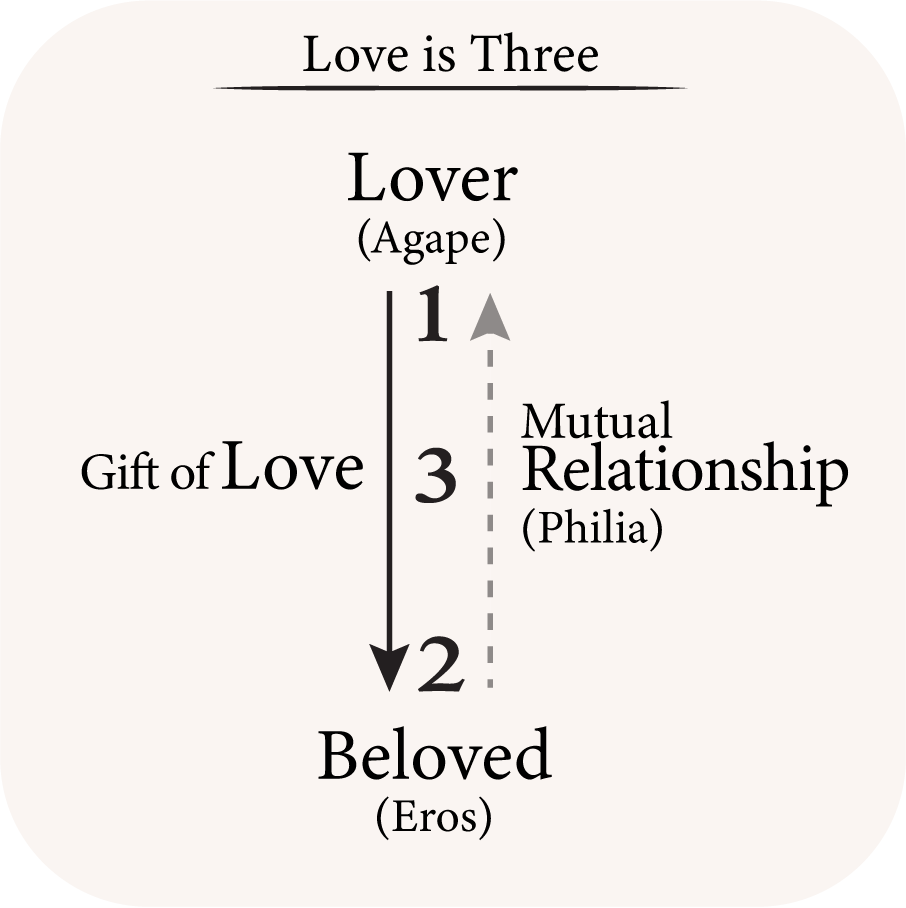
“Love, by its very nature, is inherently three. Consider that if you are in a relationship with someone, then there is you (one), the other person (two), and a third thing which emerges — the relationship between you! This relationship is truly distinct, for we can see that the relationship may be doing well even while you both are doing poorly — or you both could be doing excellently while the relationship suffers. Thus, it is apparent that even in this elementary way, love is inherently fruitful, leading to something new! In this way, the minimum number for love is always three… though it is a trinity in unity.”
—Daniel Hickman, Why is God Trinity?
Other Associations
Planet: Primarily Jupiter.
Enneagram: 3 is the Achiever and is archetypically masculine. Holy Law, Holy Hope, and Holy Harmony.
Kabbala Sephirah: Binah (understanding).
Tarot: The Empress. Nurturing, creativity, abundance, new projects.
Which number is usually first? 7 of course! See: https://www.scientificamerican.com/article/most-popular-numbers-grapes-of-math/
7 and 3 are favorite numbers across the West, Arab world, India, and Africa, though in some cultures their favor may be mixed or surpassed by other numbers. Notably, in China, 6 and 8 are strong contenders, largely because the words for these numbers sound like other nice words (like “wealth” and “smooth”).
Note that these are the two moves of 2nd Tier Consciousness in the Spiral: Yellow (include) and Turquoise (transcend).
The Bible is clear that “3 days” (and three complete days) is the number to consider as Jesus’ time in the grave, even though the math doesn’t add up in a quantitative sense. This is an excellent example of the Bible’s use of numbers qualitatively rather than quantitatively :)
This is a bit of a rabbit-trail to go down, but essentially, Jesus recorded as dying at 3pm (the 9th hour) on Friday, was in the tomb the whole of the Sabbath, and rose with the sun on Sunday, which would be about 36-40 hours (1.5 days), 2 evenings and 2 mornings. Yet Jesus himself prophesied this time as 3 days and 3 nights:
Matthew 12:40 (“for 3 days and 3 nights the Son of Man will be in the heart of the earth”)
Mark 8:31 (“after 3 days rise again”)
Luke 9:22 (“on the 3rd day be raised”)
1 Corinthians 15:4 (“on the 3rd day”)
This is the classic gematria system, where aleph = 1, bet = 2, gimel = 3… and yod = 10, kaf = 20, lamed = 30, etc… I don’t like to get too crazy (or make big leaps) with gematria, but I find it helpful to include simple gematria when it re-enforces a good point.