
Why is God Trinity?
History, doctrine, and implications of the Divine Trinity.

Volumes have been written about the never-ending mystery of God in three Persons. It’s a core doctrine of Christianity1 that God is One, yet that God is also Three, or as commonly expressed, “God is Three-In-One.” The specific three referenced are:
God the Father
God the Son (the Logos, who was enfleshed as Jesus of Nazareth)
God the Spirit (the Holy Ghost)
For some, the Trinity is a stumbling-block to accepting Christianity — it is, after all, a mathematical contradiction. For some, it’s merely an odd quirk — a strange choice of a hill to die on. For others, the Trinity is a main draw to Christianity (see Jordan Hall’s journey into Christianity: Jordan Hall - The Trinity as the key to the structure of being), and an integral aspect that sets it apart from other religions.
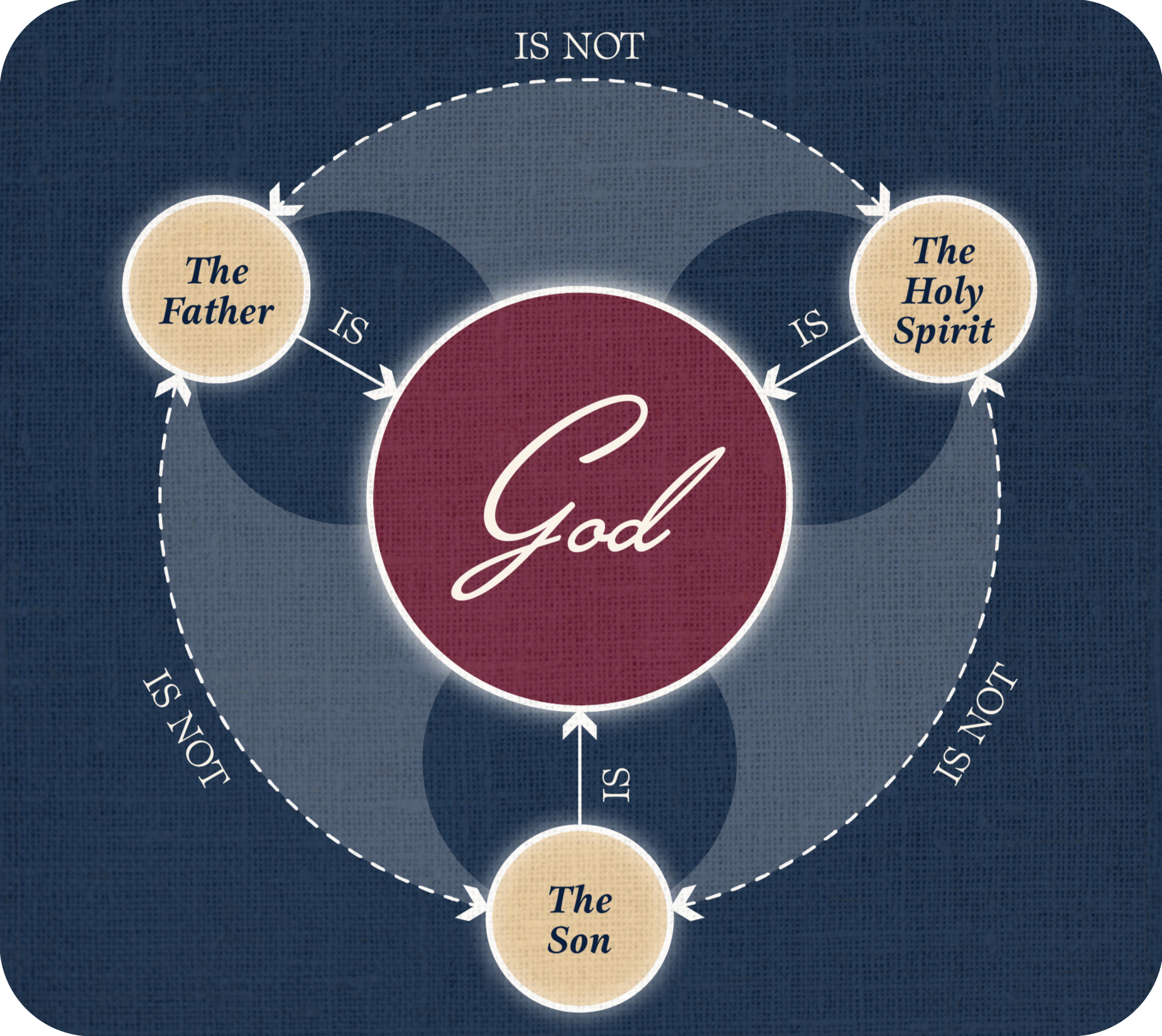
Below is the classic shield of faith diagram, depicting the oneness and differentiation of the Trinity.
How the Doctrine Developed (Summary)
The teaching of the Trinity is not found directly anywhere in the Bible. The term “trinity” isn’t from the Bible, nor does the Bible directly call God three. Yet, the concept of “the Trinity” is certainly a flowering from Biblical seeds, a synthesis of the Bible’s implications, and in continuity with what it says.
Early Christians had undeniable experience of the Lordship of Jesus, the Lordship of the Spirit, and of course, the Lordship of God… yet this was difficult to reconcile with their strong belief in only one Adonai (Lord) God. The attempts to reconcile experience with scripture, tradition, and reason led to the articulation that Jesus and the Spirit were also “true God.”
However, the language about the Trinity took over 300 years to mature. This was a gradual process, taking place through the multi-cultural network of church communities and fleshed-out by theological scholarship, not something invented by any one gathering or council. There is no particular “point” at which the doctrine was defined or invented. Notable moments include the first known use of the world “trinity” (“trinitas” — Tertullian ~212CE), the first ecumenical council (Nicaea 325CE, which actually defined no trinitarian theology directly, but did affirm the Son to be of one substance with the Father), and the Cappadocian Fathers (350-390CE) who wrote sophisticated theology about the Trinity. Yet any attempt to pinpoint a single moment is far too reductionistic.
Doctrine and Implications
The doctrine that was developed by the Church has profound implications, for how we see and talk about God changes how we see ourselves, others, and the world. As I explain the core features of the Trinitarian doctrines, you may be able to see how it leads to a relational metaphysics, an integrative epistemology, and an ethic of Love.
Below is a 7-point summary of the core doctrines and key features of the Divine Trinity — each well-accepted teachings about God within Christianity:2
1. One
God is one. God is whole, united, absolute, and perfect. It is important that the true God is not split across many agendas, values, spirits, or little-g gods. All of creation, being made from God, does not have to choose amongst a myriad of gods or conflicting goods and purposes, but can live according to the One Good, the One Purpose, and the One Truth. Everything comes from one Source and everything is destined towards one Infinite End. Everything finds its place in one God.
“Hear, O Israel: The Lord is our God, the Lord is one!” —Deuteronomy 6:4
2. Three
God is three. Not two, nor four: three. The early church came to this conclusion because of their experience of the lordship and divinity of Jesus Christ, of the Holy Spirit, and of God the Father, drawing upon insights gleaned from their sacred texts, and reasoning about the nature of God. Despite centuries of debate and controversy, the threeness of God became a core doctrine of the faith (alongside the oneness of God). The three Persons of God (the Father, the Son, and the Holy Spirit) were all considered distinct, yet all God. In English, “person” is the conventional term for one of the three, while in Latin it was persona (mask, role), and in Greek it was hypostasis (substance, underlying reality). The three-in-one mystery is depicted in the classic “shield of faith” diagram (above).
“We worship one God in trinity and the trinity in unity… For the person of the Father is a distinct person, the person of the Son is another, and that of the Holy Spirit still another. But the divinity of the Father, Son, and Holy Spirit is one, their glory equal, their majesty coeternal.” —The Athanasian Creed
3. Transcendent
God is transcendent, “high above,” and infinite. God, always so far beyond us, calls us out of ourselves, up to the heights, and into the continual more. In experiencing God’s transcendence, we are humbled in awe by his glory, and are led to speak of God as all-present, all-knowing, and all-powerful… yet even these terms fail to capture the nature of a God who is not bound by time nor space, life nor death. God is the uncreated creator, the uncaused cause, and the unmoved mover.
God is not merely the greatest being among beings, but Being itself. In this way, God does not exist, but is Existence itself. God is the Ground of Being – that upon which all other things source their being. God is the highest Good, the most radiant Beauty, the most lucid Truth… and the grounding in and through which all goodness, beauty, and truth flow. Whatever is the greatest, most wondrous, awe-inspiring thing we imagine or feel… God is there, and beyond!
“The being of God cannot be understood as the existence of a being alongside others or above others. If God is a being, he is subject to the categories of finitude, especially to space and substance. Even if he is called the “highest being” in the sense of the “most perfect” and the “most powerful” being, this situation is not changed. When applied to God, superlatives become diminutives… Many confusions in the doctrine of God and many apologetic weaknesses could be avoided if God were understood first of all as being-itself or as the ground of being.” —Paul Tillich (Systematic Theology)
4. Historical
God is present within time, part of history, and imminent (near and present to creation). This allows us to authentically relate with God. God enters into history, makes covenants with his people, inspires sacred texts, affects events, and acts like a person. God is more properly a “he” than an “it.” The greatest example of God’s imminent, personal historicity is in the person of Jesus Christ. Somehow, the transcendent awesomeness of Being itself was living as a historical human being! This person, then, bridges between the finite and the infinite. While some see the eternal transcendence of God as a reason that God cannot be changeable, dependent, humble, meek, emotional, suffering, learning, growing, or relative, Jesus shows us that God in fact is all these things.
Jesus, visible image of the invisible God, reveals that God suffers, and not just the suffering of pain, but the suffering of what life is – to be subject to and changed by existence. The word “suffer” comes from the Latin sufferre (sub-ferre, literally under-carry) which means to undergo or to bear up under. God is not only above the world, but undergoes the world – God suffers it. God does this because God loves the world, and one cannot fully love without being changed by that which one loves. One cannot love without suffering (under-going).
“A God who cannot suffer is poorer than any man. For a God who is incapable of suffering is a being who cannot be involved. Suffering and injustice do not affect him. And because he is so completely insensitive, he cannot be affected or shaken by anything. He cannot weep, for he has no tears. But the one who cannot suffer cannot love either. So he is also a loveless being.” —Jürgen Moltmann (The Crucified God)
5. Relational
God is inherently relational, communal, dynamic, and intimate. God is Relationship itself. For God is the Relation of the Trinity just as much as the Persons of the Trinity. God’s essence is Father, Son, and Spirit — all loving each other, moving with each other — dancing, playing, and singing together! The Persons of the Trinity are described as interpenetrating each other (a mutual indwelling) for wherever one Person is, so the other two are present (they cannot exist apart from each other). In fact, every act performed by one Person of the Trinity is also performed by all three, for they are inseparable. They get up and lie down together. They breathe together. They are perfectly unified, yet still distinctly themselves — unity in diversity.
Some describe the relationality of the Trinity as the Divine Dance. It is through the intimacy of this Divine Dance that all creation is birthed, and creation is invited to participate within (to live in-step with) the harmony of the Trinitarian Life. Every person is able to learn the steps and overcome the initial awkwardness of learning the Dance. God is not just “up there” and “in here” but found in the movement “between us” — within all authentically loving relationships.
“All you can do is surrender and enter into this dance of unhindered dialogue, this circle of praise, this web of communion that we call the Blessed Trinity.” —Richard Rohr (The Divine Dance)
6. Mysterious
God is mysterious, ineffable, and paradoxical. God cannot be captured by our intellect and all language falls short of understanding God… in fact, the mystics often teach that the way to intimately know God is not through intellectual comprehension but intellectual darkness. For we can never grasp God with our minds, but only with our hearts. Though God is Light, he is maker of the night. Though God is Word, he is found in silence. Even our glimmers of insight about God often appear contradictory, like God being one and three, transcendent and historical, unchanging and dynamic.
When it comes to these paradoxes, Christian theology maintains a devoted both-and position, which promotes wrestling/engagement and indicates truth is in the mystery. God will always exceed our understanding. But through dialectical thinking — taking two opposing views and putting them in dialogue with each other — a third thing emerges: a truth that transcends and includes both. God Themself is like this: the Persons of the Trinity transcend each other and include each other, maximally, simultaneously.
“Christianity got over the difficulty of combining furious opposites, by keeping them both, and keeping them both furious.” —G.K. Chesterton (Orthodoxy)
7. Love
God is generous, compassionate, forgiving, patient, longsuffering, fruitful, and self-sacrificial. God is perfect, cosmic, never-ending love! To say “God is love” is to say that reality is birthed from love, living within love, and destined to love!
Love is a gift-of-self. So God, being the most loving love, fully gives Godself away. Christian doctrine expresses this truth through Trinitarian language: that God the Father “births” a Son (who is of the same “stuff” as God), and thus the Father is able to completely give Himself away, emptying Himself into the Son. And the Son reciprocates, giving Himself to the Father. And their love for one another — their relationship — is so complete and real, so personable and Divine, that it is itself a Divine Person, the Spirit of God. Thus there is the one who births (the Father) and the one who is birthed (the Son) and the birthing relationship (the Spirit).
There is Father, Son, and Spirit – Lover, Beloved, and Love – the Source, the Emergence, and the Relationship between the two!
Love, by its very nature, is inherently three. Consider that if you are in a relationship with someone, then there is you (one), the other person (two), and a third thing which emerges – the relationship between you! This relationship is truly distinct, for we can see that the relationship may be doing well even while you both are doing poorly — or you both could be doing excellently while the relationship suffers. Thus, it is apparent that even in this elementary way, love is inherently fruitful, leading to something new! In this way, the minimum number for love is always three… though it is a trinity in unity.
“God is love, and those who abide in love abide in God, and God abides in them.” —1 John 4:16
Final Notes
Hopefully you now see much value in the Christian doctrine of the Trinity!
Before ending, I’d like make a few notes on how Trinitarian doctrine can (and cannot) be expressed:
It is longstanding tradition to explain the Trinity as one “Being” or “What is” (God) and three “Persons” or “Who is” (Father, Son, Spirit).
The Western churches affirm that the Spirit “proceeds from the Father and the Son,” while the Eastern churches tend to disagree, though they affirm that the Spirit “proceeds from the Father through the Son.” Personally, I don’t see that there has to be any difference between the two, but I agree with the Eastern churches that we can’t forget the monarchy (primacy) of the Father.
Many people like using analogies like Water-Ice-Vapor (this one is pretty bad) or Sun-Ray-Heat (much better but still flawed) for understanding the Trinity. Analogies don’t have to be perfect (in fact, no earthly analogy can be), but it’s important to remember that all the Persons are present wherever one is, every activity done by one Person is done by all three, and all three Persons are co-equal in glory and divinity.
That’s it for now. But soon I’ll be posting more on how the Trinity informs reality. Feel free to comment any questions below!
Image Credits: The shield of faith diagram was made by Jacob Bernans, the Illustrator of my book: “A Trinity in All Things,” which is set to be published this summer! Keep an eye out for its release :)
How core are we talking? The three main branches of Christianity: Orthodox, Catholic, and Protestant consider it extremely core doctrine. These groups would say that, if a religious group denies the Trinity, it either isn’t Christian, or is in major error. However, there are Christian Unitarians and Oneness Pentecostals and Mormons and Jehovah’s Witnesses, all of which deny the Trinity, yet consider themselves Christian.
When discussing God, particularly the Trinity, there will always be disagreement. While I try to be fair to a variety of Christian traditions while adhering fully to orthodoxy, these descriptions will inevitably reflect my own emphases.