
4 (ד): Earth and Humanity
The Biblical symbolism of the number 4. Stability, Justice, Rule, Materiality, Mortality, Trial, Suffering.

Today we continue our series on Biblical Numerology, considering the beautiful and rich number 4, with all its pain, difficulty, and nuance.
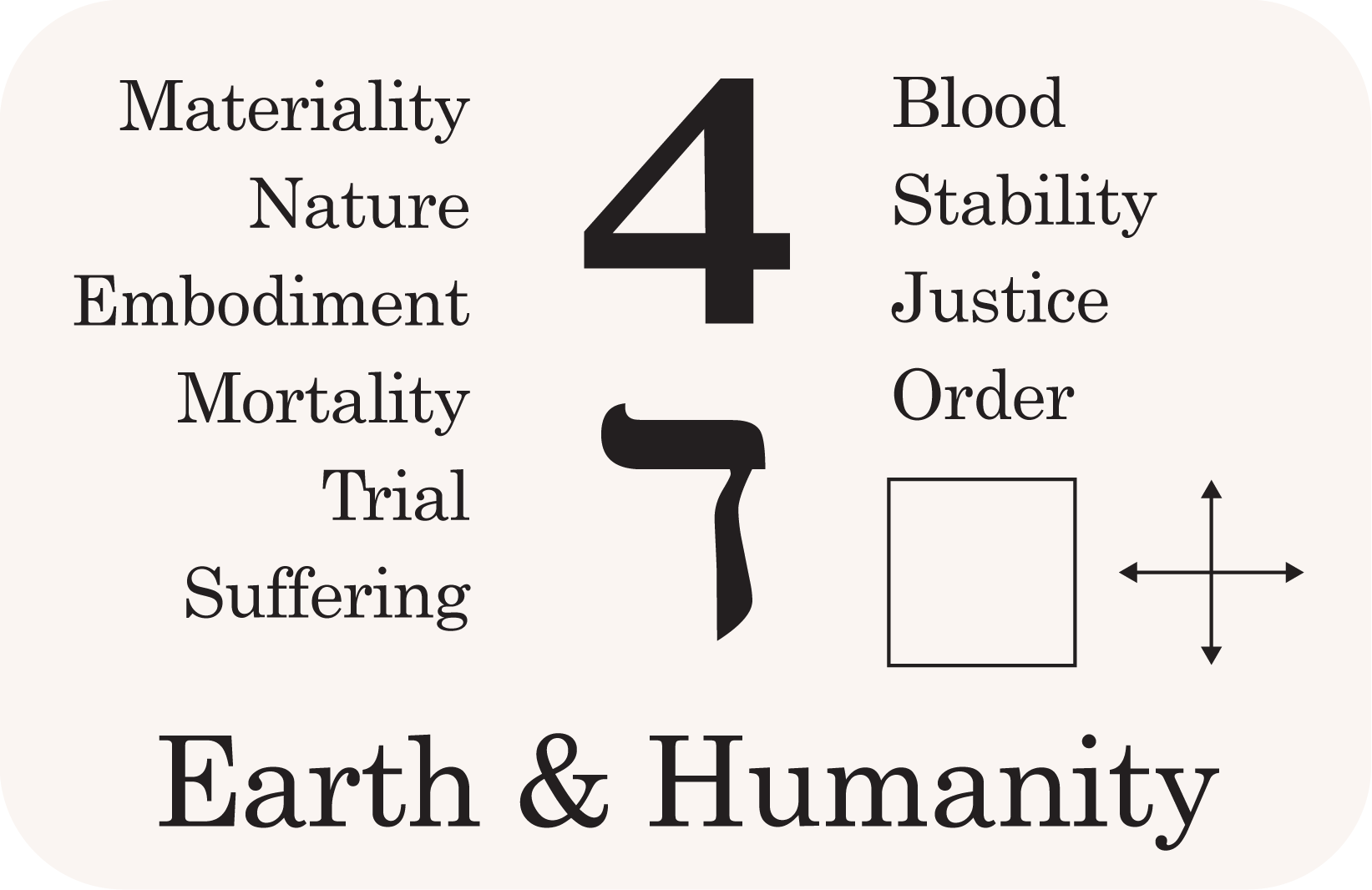
Earth and Humanity
If 3 is a divine and heavenly number (a triangle pointed to the heavens) then 4 is a human and earthly number (a square foundation). There are many reasons 4 is a number of the earth number including the following:
4 corners of the earth
4 winds
4 cardinal directions
4 seasons
4 primary elements (earth/water/fire/air)
a grid on a map (grids are squares — 4 sides, 4 angles — and latitude x longitude makes a (spherical) grid)
4 fundamental forces of nature (gravity, electromagnetism, strong force, weak force)
The earth is filled with 4s. And out of the earth comes humanity, who is part of the earth. We see this symbolically in the Genesis 2 narrative, where God creates humanity (adam) by shaping them from the dust of the earth (adamah1). Then God places them in a beautiful garden, surrounded by 4 rivers.
Genesis 2:10-14: A river flows out of Eden to water the garden, and from there it divides and becomes four branches. The name of the first is Pishon; it is the one that flows around the whole land of Havilah, where there is gold, and the gold of that land is good; bdellium and onyx stone are there. The name of the second river is Gihon; it is the one that flows around the whole land of Cush. The name of the third river is Tigris, which flows east of Assyria. And the fourth river is the Euphrates.
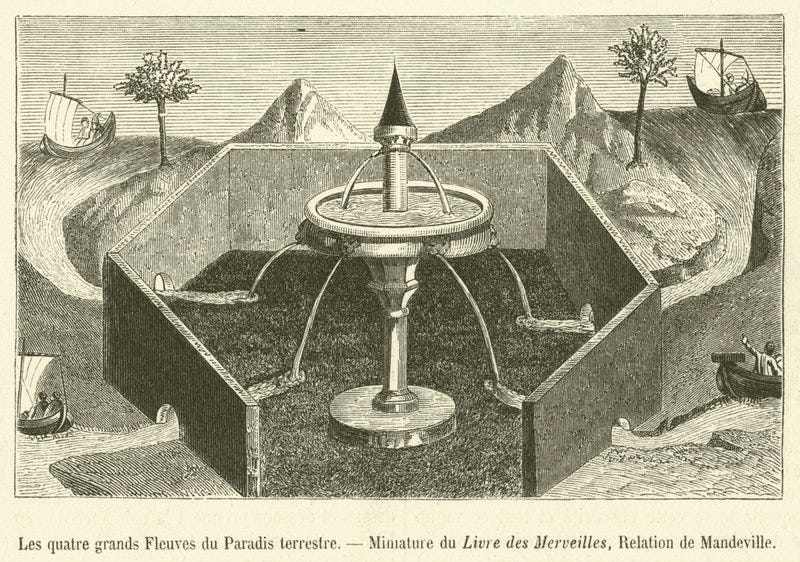
A garden is a natural (earthly) space which is properly ordered/structured such as to bring about great abundance. The job of adam (humanity) was to be a gardener: to learn how to garden well in Eden and then spread that garden-life throughout the world (flowing out like the 4 rivers).
The garden is a safe space of stability and order, but not in a stifling way. It is in harmony with nature, which is God’s law. The number 4 is associated with all of these things, for 4 is a stable number (the stability of a 4-legged table) and a number of order (well-defined right-angles), and of humanity, of nature, of law and order, and of the moral law of justice.
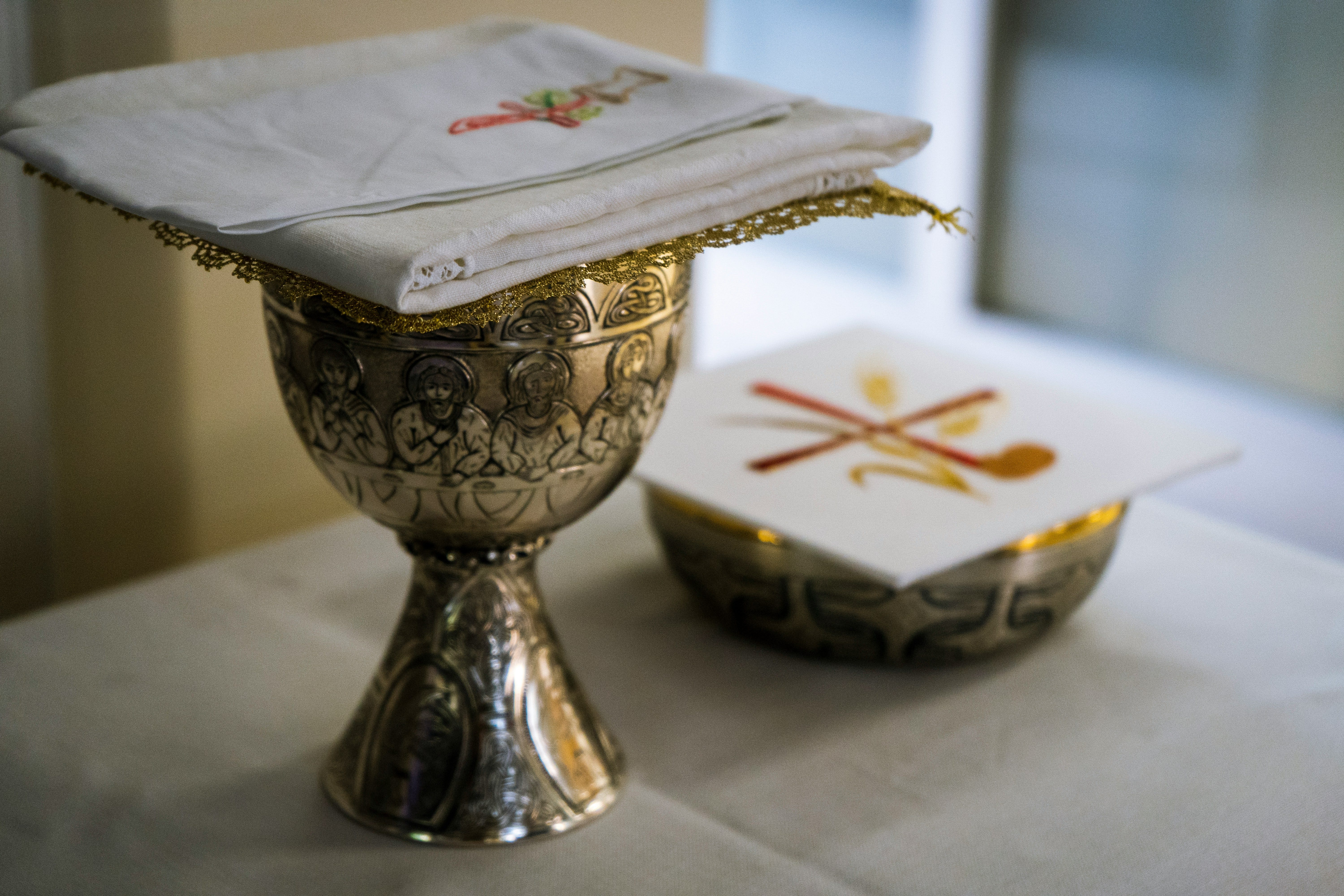
Altars in churches usually have 4 corners, and are traditionally perfectly square, in order to symbolize the presence of God’s order and justice extending throughout the whole world and to all peoples.2
Stability and Justice
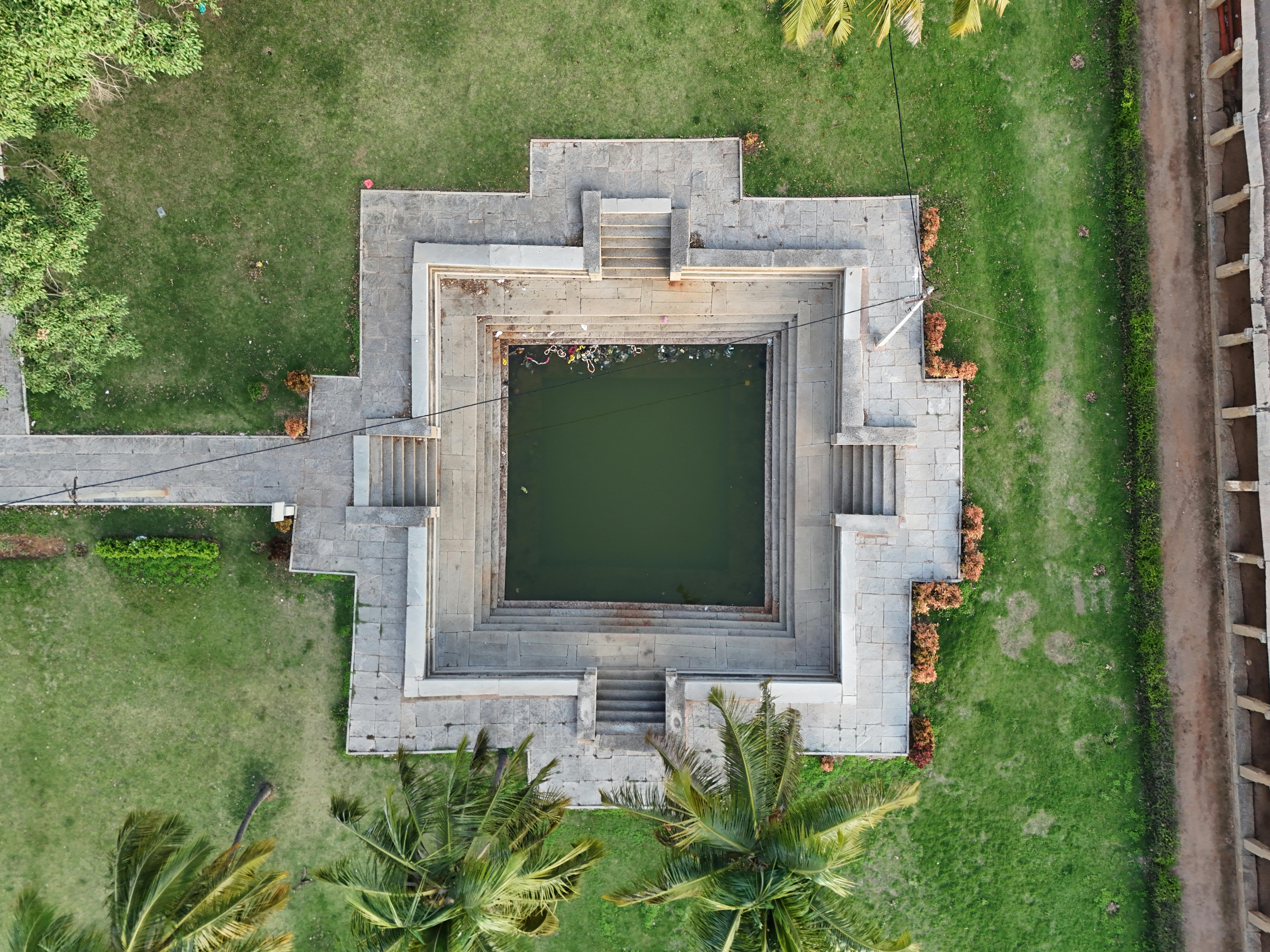
As already mentioned, 4 is a number of stability, which makes sense as the earth provides literal groundedness and humans seek and build stability (often through making 4-sided shapes like 4-walled houses and 4-sided crop fields/plots). Stability is a common cross-cultural association with the number 4. In Shaolin Kung Fu (which I recently started practicing), we speak of the square as our stability, body, earth, and internal training.3 Pythagoras thought of 4 as a stable, earthly number, and as a number of justice, for 2 x 2 is a balance of equals… and each square has equal sides which face each other and balance each other out.
2 is separation & balance (this is the base of differentiation — light & dark, waters from waters, ish & isha)
4 is order & stability (the “balance of balances” that endures over time)
6 is uniformity & union (for the “stability of stabilities” can become too uniform)
Law and Rule
Also associated with the number 4 is natural law and human rule (and human law and natural rule). On the 4th day of creation, God created the first rulers of creation, which were not humans, but the natural rulers of the sun and moon:
God made two great lights—the greater light to rule (מֶמְשָׁלָה, memshala) over the day and the lesser light to rule (מֶמְשָׁלָה) over the night. He made the stars also. God placed the lights in the expanse of the sky to shine on the earth, to preside (לִמְשֹׁל, memshol) over the day and the night, and to separate (הַבְדִּיל, havdeel, from badal) the light from the darkness. God saw that it was good. There was evening, and there was morning, a fourth day. —Genesis 1:16-19 (NET)
I find the parallels between the sun/moon and humanity quite interesting, the first living in the heavens, the second upon the dry land. The former rules the day/night while the latter rule over “all creatures that move upon the earth.” When the sun and the moon separate day from night by how they rule, they shine ordered cycles upon the earth so it may flourish. Similarly, humanity is meant to, through their own creativity and ordering, shine God’s light from the garden, promoting the flourishing of all the earth!
The number 4, or rather 40 (which is nearly equivalent, symbolically) appears as the number of years that king Saul reigned…4 and also the number of years king David reigned…5 and also the number of years king Solomon reigned.6 The noting of these 40-year reigns is likely meant to evoke ideas of the stable order and just rule of these kings. Put together, this would be a triad (divine) of 40 (stable rule) for a total of 120 years (12 tribes).
But, as we are about to discuss, 40 can also be a number of “trial” and “finitude.” It’s quite possible to interpret the reign of these kings, not as something stable and just, but as the cause of great suffering that had to be endured! After all, God didn’t want Israel to have kings, and Samuel prophesied that the kings of Israel would be corrupt, and “in that day you [Israel] will cry out because of your king whom you have chosen for yourselves, but the Lord won’t answer you in that day,”7 for the rulership of any king but God will necessarily lead to rebellion against God in the form of corruption and injustice.
An important principle of numerology is that it’s never as simple as “this number is good” or “this number is bad.” In the case of 4, the wide range of meanings lead it to be a very flexible and powerful number, able to be interpreted as needed to address the concerns of different individuals who come to the text.
Trial, Suffering, and Mortality
While 3 is a number of heaven and immateriality, 4 is a number of the earth and materiality. What comes with materiality? Finitude. Mortality. All that is “under the sun” comes and goes. The human life is but a puff of smoke.
I have seen all the actions done under the sun, and, look, it is all nothing but vapor. It is all chasing the wind. —Ecclesiastes 1:14 (EHV)
What is your life like? For you are a puff of smoke that appears for a short time and then vanishes. —James 4:14 (NET)
Four is not just a number about the justice and order of materiality, but of the pain and limitation of the mortal experience, for “to live is to suffer.”8 In particular, the Bible uses the number 4 (and 40) to indicate suffering and trial:
40 days and 40 nights of flood rains9
40 years wandering in the desert10
40 days Jesus fasted11
4 points of the cross
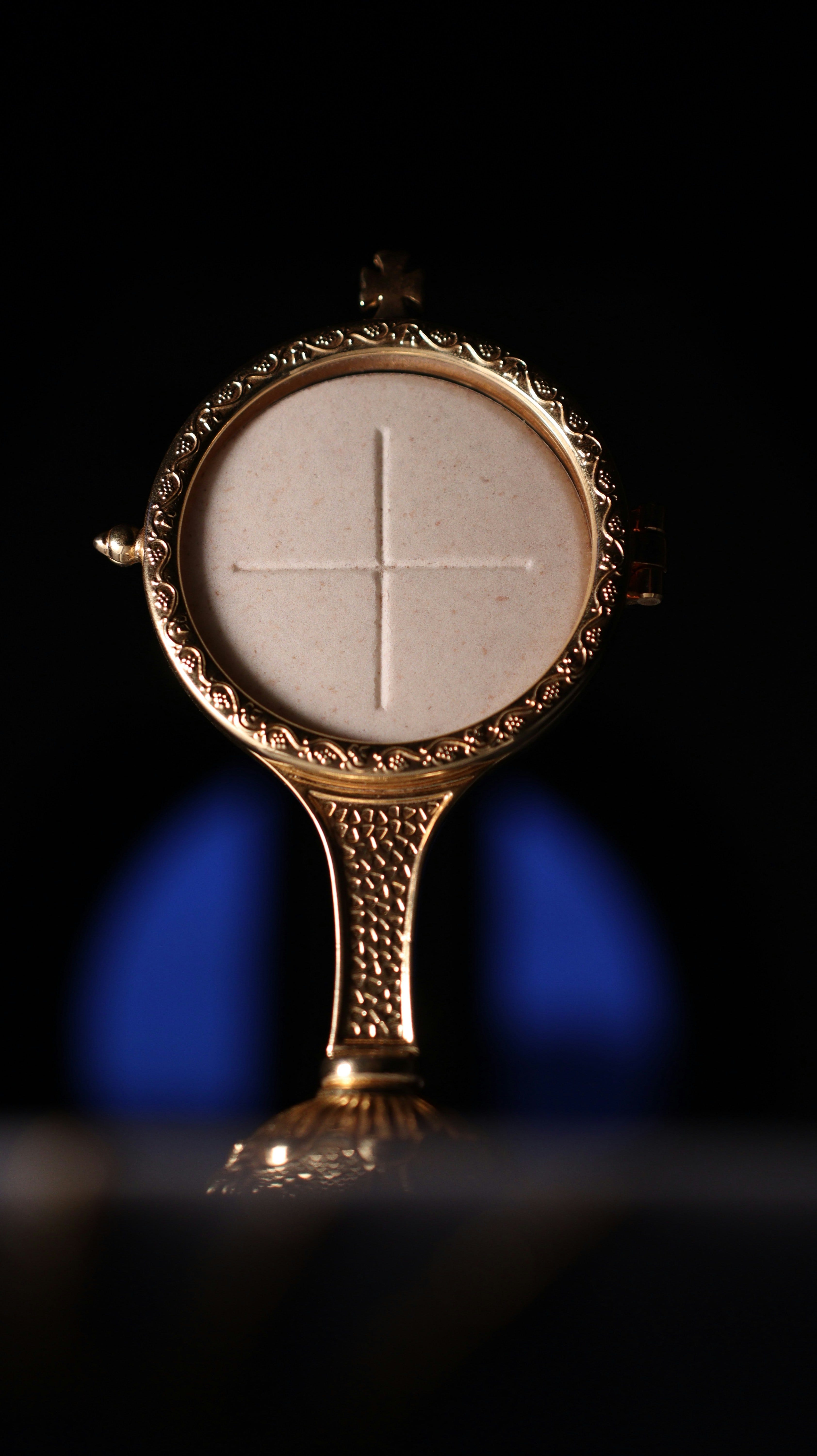
In Japan, the number 4 is strongly associated with death, since “four” and “death” are both pronounced “shi.” The same association exists in China and Korea, also because of how similar the words for “four” and “death” sound.12
Dalet (ד) and Dam (Blood)
The letter ד (dalet) represents 4 in Hebrew and sounds like a “d.” The first word in the Bible that starts with dalet is דֶּשֶׁא (deshe) which means grass, herb, or vegetation, strengthening the “earth” and “nature” association.
If dalet is spelled out (דֶּלֶת), it means “door,” which strengthens the rectangular stability of 4, but may also indicate a kind of possibility and potential for transition.
Notably, the word for blood, דָּם (dam) is equal to 44 (ד(4)+ם(40)), and first appears in the Bible as Abel’s blood crying out from the ground.
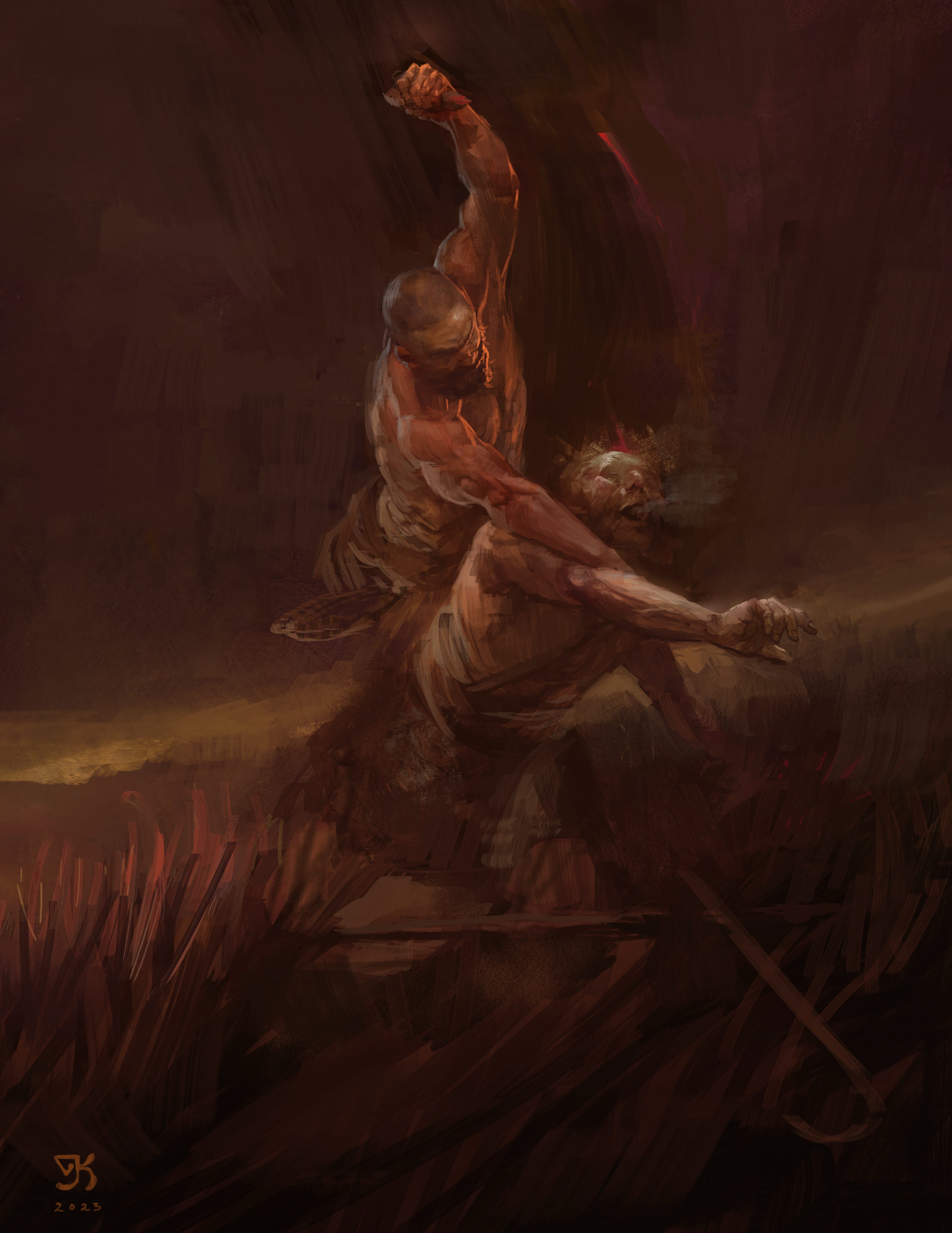
Cain said to his brother Abel,13 “Let’s go out to the field.” (בַּשָּׂדֶה, shadeh) While they were in the field, Cain attacked his brother Abel and killed him.
But the Lord said, “What have you done? The voice of your brother’s blood (קוֹל דְּמֵי, kol dam-ey) is crying out to me from the ground! (הָאֲדָמָה, adamah) So now you are banished from the ground, which has opened its mouth to receive your brother’s blood from your hand (מִיָּדֶךָ, yad). When you try to cultivate (תַעֲבֹד, avad, serve) the ground it will no longer yield its best for you. You will be a homeless wanderer on the earth.”
—Genesis 4: 8, 10-12 (NET)
This imagery, of Abel’s blood soaked into the ground, unifies the 4-ish imagery of earth, humanity, suffering, and mortality. If there’s any connection to stability and rule, it is to be found in Cain, who tilled the ground and founded the first city.
If pressed to give a short answer to the question: “What does the number four mean in the Bible?” I tend to say something like, “Four represents the order of the earth and the totality of the human experience.” Four is both the glory and imperfection of our world.
Other Systems
Planet: Planetary associations with numbers often have significant disputes amongst systems, but 4 is especially variable. Uranus, the shadow-planet Rahu, and the Earth itself are the most common.
Enneagram: 4 is the Individualist or Romantic who feels deeply and is most prone to suffering and experiencing the depth and darkness of life. The vice is Envy and virtue is Equanimity. The Holy Idea is Holy Origin.
Kabbala Sephirah: Chesed (Mercy).
Tarot: The Emperor. Authority, rulership, structure, control, stability, discipline.
Genesis 2:7: Then the Lord God formed man (אָדָם) from the dust of the ground (אֲדָמָה).
The Israelite altars of the burnt offering and of the incense were also square: “You shall make the altar of acacia wood, five cubits long and five cubits wide; the altar shall be square, and it shall be three cubits high.” (Ex27:1) “You shall make an altar on which to offer incense; you shall make it of acacia wood. It shall be one cubit long and one cubit wide; it shall be square and shall be two cubits high.” (Ex30:1-2)
The circle is flow, adaptability, and heaven… while the triangle is energy to center, angles, efficiency, and penetration.
Acts 13:21. If you want a rabbit trail to follow, 1 Samuel 13:1 mentions Saul reigned 2 years, but there’s clearly some confusions in the manuscripts we have about what the number is supposed to be.
2 Samuel 5:4-5, 1 Kings 2:11
1 Kings 11:42
The first of the 4 noble truths.
Genesis 7:4: For in seven days I will cause it to rain on the earth for forty days and forty nights, and I will wipe from the face of the ground every living thing that I have made.
Numbers 32:12: And the Lord’s anger was kindled against Israel, and he made them wander in the wilderness for forty years, until all the generation that had done evil in the sight of the Lord had disappeared.
Matthew 2:1-2: Then Jesus was led by the Spirit into the wilderness to be tempted by the devil. After he fasted forty days and forty nights he was famished.
This leads to hotels labeling the 4th floor with “F” or people otherwise avoiding the number 4, much like the number 13 has superstition built up around it in the West. This phenomenon is called tetraphobia: https://en.wikipedia.org/wiki/Tetraphobia
Note that the name Abel (הבל) is the same as the Hebrew word hevel (הבל), meaning vapor, smoke, or short-lived.
I like how you mention the order and stability of the altar. Check out an image of the altar in the restored Notre Dame of Paris. I am highly uncomfortable with how the shape of this altar intentionally (and I would add radically) subverts the themes that you discuss. It appears to me like it is shaped to tip over and spill. The baptismal font does something similar. They also appear to lack any decoration or ornateness. Just thought this was an interesting point of reference and contrast to the typical pattern.