
A Framework for Everything
Intro to Spiral Dynamics

If you’ve known me long enough, you’ve probably heard me talk about Spiral Dynamics. Perhaps after the Enneagram, it’s the framework I reference the most! It’s useful for SO many things, and has helped me immensely with personal growth. I’ve worked with the Spiral for over a decade now, and have added my own touches to the theory1 😊 So whether you’re a friend reading this or a stranger pursuing the latest on Spiral theory, I’m excited to share the Spiral with you!!
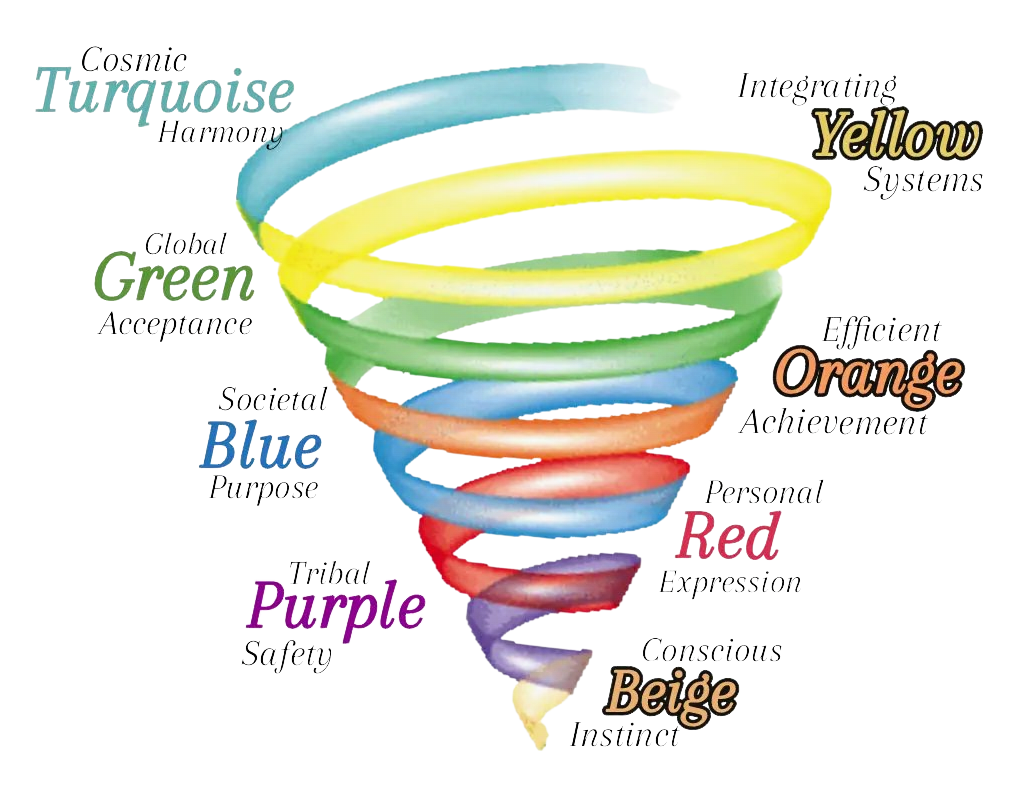
Spiral Dynamics is a development model which provides a language for understanding human (individual) and societal (collective) development, across many domains such as conflict resolution, geopolitics, motivational schemas, human needs, psycho-social development, education, political systems, and more!
It was developed by Clare Graves (1960s) and refined and expanded by Don Beck and Christopher Cowan (1980s). It can be seen as a synthesis or meta-model of many development models, such as Maslow’s needs, Gebser’s worldviews, Piaget’s cognitive capabilities, Erickson’s psychosocial life stages, Fowler’s faith stages, Kegan’s social–emotional framework, and Cook-Greuter’s leadership maturity.
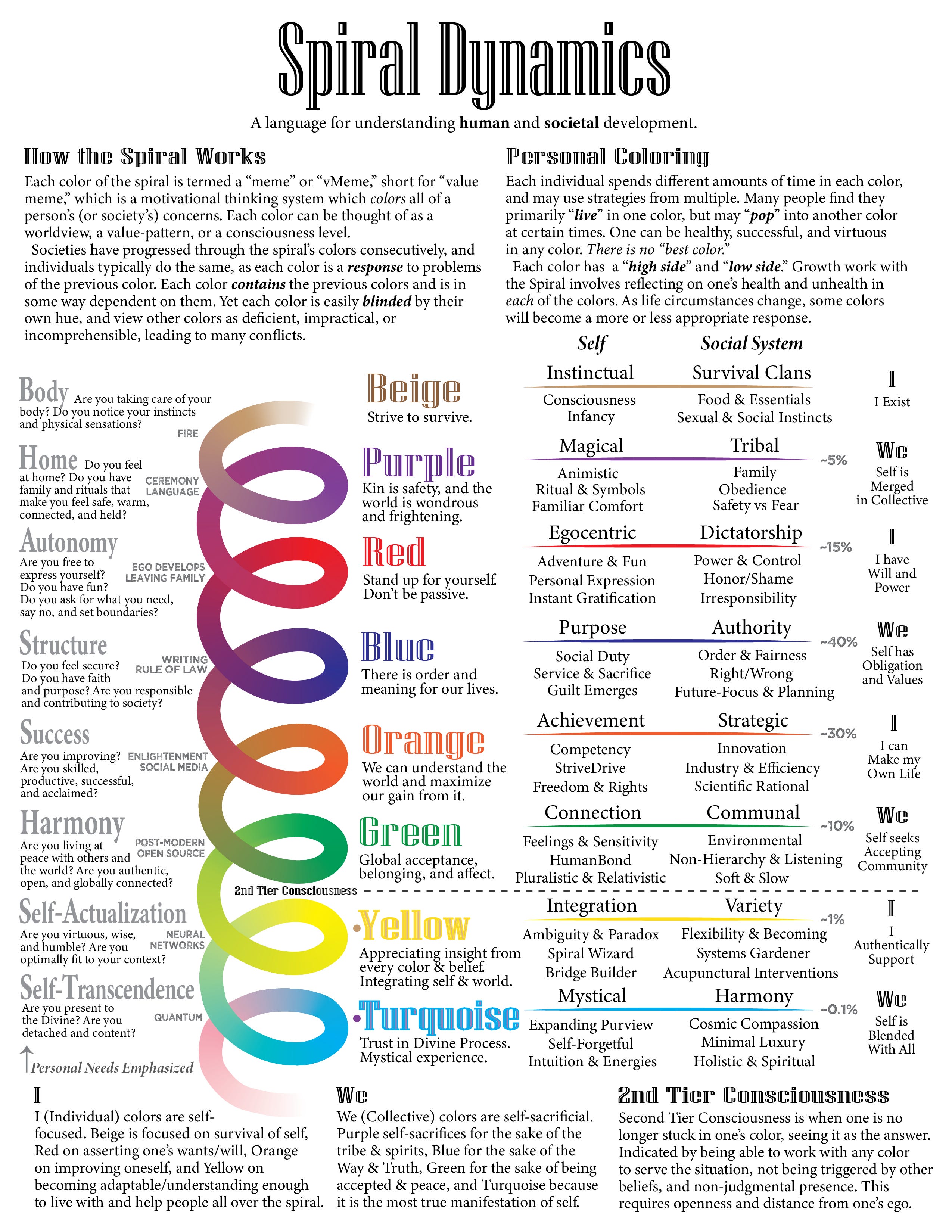
The theory states that individuals and collectives “move through” the colors of the Spiral in order, from 🤎Beige (SurvivalSense) → 💜Purple (KinSpirits) → ❤️Red (PowerGods) → 💙Blue (TruthForce) → 🧡Orange (StriveDrive) → 💚Green (HumanBond) → 💛Yellow (FlexFlow) → 🩵Turquoise (WholeView).
The first key to understanding the Spiral (and why it’s shaped like a spiral) is that each level “transcends and includes” the others. That means that the 2nd level, 💜Purple, includes the first level, 🤎Beige. And that the 3rd level, ❤️Red, includes both Purple and Beige. The 4th level, 💙Blue, includes Red, Purple, and Beige. Etc. It’s as if every time there’s a movement to a new color, the spiral “loops” around, so it’s back at the “same point,” but also at another level (hence spiral!). Each color is built upon the previous, so it’s generally considered not possible to “skip” levels.2
The second key to understanding the Spiral is that there is no best color. Higher colors aren’t better even though they are more progressed and lower colors aren’t better even though they are more foundational. Certain “life conditions” may make one color more adaptive than another, and certain situations may be better addressed by one color or another, but all colors have their proper place and are essential in their own way.
The Spiral pendulum-swings between Individual (I) colors (🤎❤️🧡💛) and Collective (We) colors (💜💙💚🩵). This back-and-forth movement is because all of us must move between self-focus (my need for individuality and to be a unity of parts) and self-sacrificing (my need for belonging and to be part of a unity).3 This is an individual-collective dialectic that we all must deal with… and which we see expressed in cultures as they develop and oscillate between the two poles.
Below is 1-pager of the Spiral Dynamics framework which use in my seminars, which should help you begin to grasp what each color is about:
For more resources on the Spiral, take a look at my website, and consider subscribing to this blog.
If you’re the kind of person who enjoys personality assessments, I’ve also created a little Spiral Dynamics Quiz that will give you a level of each color!
There’s a lot more to say about the Spiral, and I have several more articles coming down the pipeline! Which aspects of the Spiral peak your interest the most? Please share any questions or thoughts you have below!
Though I’m one to question and nuance such restrictions, especially when it comes to individuals :)
And I would propose this is not just a human phenomenon, but applies to all living things… and not merely all living things, but all aspects of reality!