
The Personal Worldview Table
The spiral dynamics of how we see the world.

Everyone sees the world differently.
Our perceptions are filtered through our pre-existing beliefs, our past experiences, our language and culture, our longings and desires, our embodiment, our values, and our faith…
The following is a table which describes 8 different worldviews which might “color” our experience of the world. Per the spiral dynamics framework, each worldview is built upon the previous. Each one has its pros and cons. Each one can be experienced at different times in life and in different areas of life (one may, for instance, tap into 💜Purple at church, 💙Blue in politics, and 🧡Orange at work).
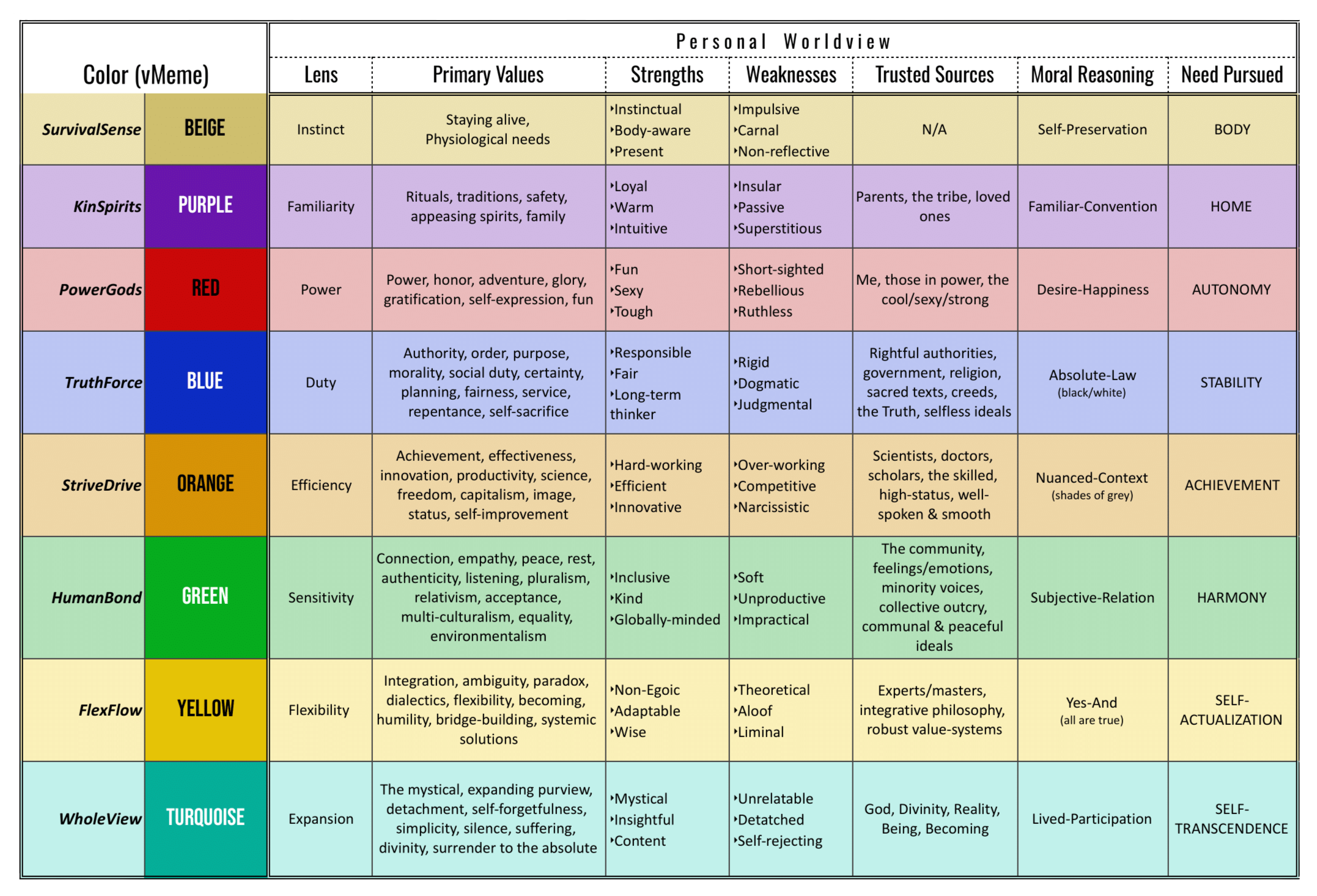
If you’d like to explore your own worldview-distribution, you may wish to take the Spiral Dynamics Personal Assessment that will give you a level of each color!
Every color is a lens through which someone can look — seeing the world through 💜Purple familiarity, ❤️Red power, 💙Blue duty… etc. These lenses can be taken on and off (and multiple looked-through at the same time), but oftentimes people will have a favorite or most-influential lens.
These lenses involve seeing the world through certain values… which in turn leads to certain strengths and weaknesses. Any color can be expressed with virtue or vice, so one might say there is a high-side and low-side to each. Healthy and virtuous people will express the strengths and avoid the weaknesses. Thus there is much diversity and growth to be had within each color. Many people have spent nearly their whole life seeing primarily through one color… and some have done this in a static, limiting way… and others in a dynamic way full of movement and improvement within their lens/valueset.
Each color is also focused on meeting certain human needs… for instance ❤️Red is focused on autonomy and freedom, whereas 💙Blue focuses on the (largely opposite) needs of stability and duty. Every person has a need for all these things (consider how I frame it in my Dialectical Needs model), and thus every person will likely tap into every color to some degree with regards to their needs.
We also can identify trusted sources of authority for every color and an associated moral reasoning for why they think some things are good and others bad. Many disagreements and misunderstandings between people (and cultures) stem from these different ways they discern goodness/morality.
I hope you’ve found this interesting and helpful! Feel free to comment your thoughts and questions.