
How does morality develop?
The spiral dynamics of moral reasoning. (Part 0/8)

How does moral reasoning develop, within oneself, within a social group, and within humanity? Spiral Dynamics provides a helpful framework for understanding this.
It can help you to identify differences in the moral reasoning of your friends. Some people are adamant about an 💙absolute moral code, others think what’s moral is highly 🧡contextual, and others question any objective grounding, since they see morality as 💚socially constructed.
How can we reconcile these different perspectives? Is it possible they all have an element of truth?💛
Looking through the spiral dynamics framework, we discover a psycho-social progression of how morality is understood (by individuals as well as cultures throughout history) — specifically through 8 different lenses.
This framework will help us recognize when someone is using a different moral reasoning than us, and communicate with them more effectively, avoiding misunderstandings. I find that many discussions where people “talk past each other” are rooted in the the different color lenses they are looking through (their differing worldviews/values).
What do we mean by morality?
For the purposes of this series “moral” simply refers to what is normatively good, valuable, right, or correct… and thus also what is wrong, bad, or incorrect.1
All our actions express a kind of “moral reasoning” whether we are aware of it or not. If I choose to eat bread rather than mud, I am expressing an implicit assessment that eating bread is better than eating mud. We all are thrown into a world where we must make all sorts of value-judgements — for as creatures we must act, and therefore choose one action over all the others.
The question then becomes, what guiding principles do we use to choose our actions? And what reasonings or justifications do we give for this? Do we follow the law? Do we do what we want? Do we do what gives us power? Do we do what promotes life for all?
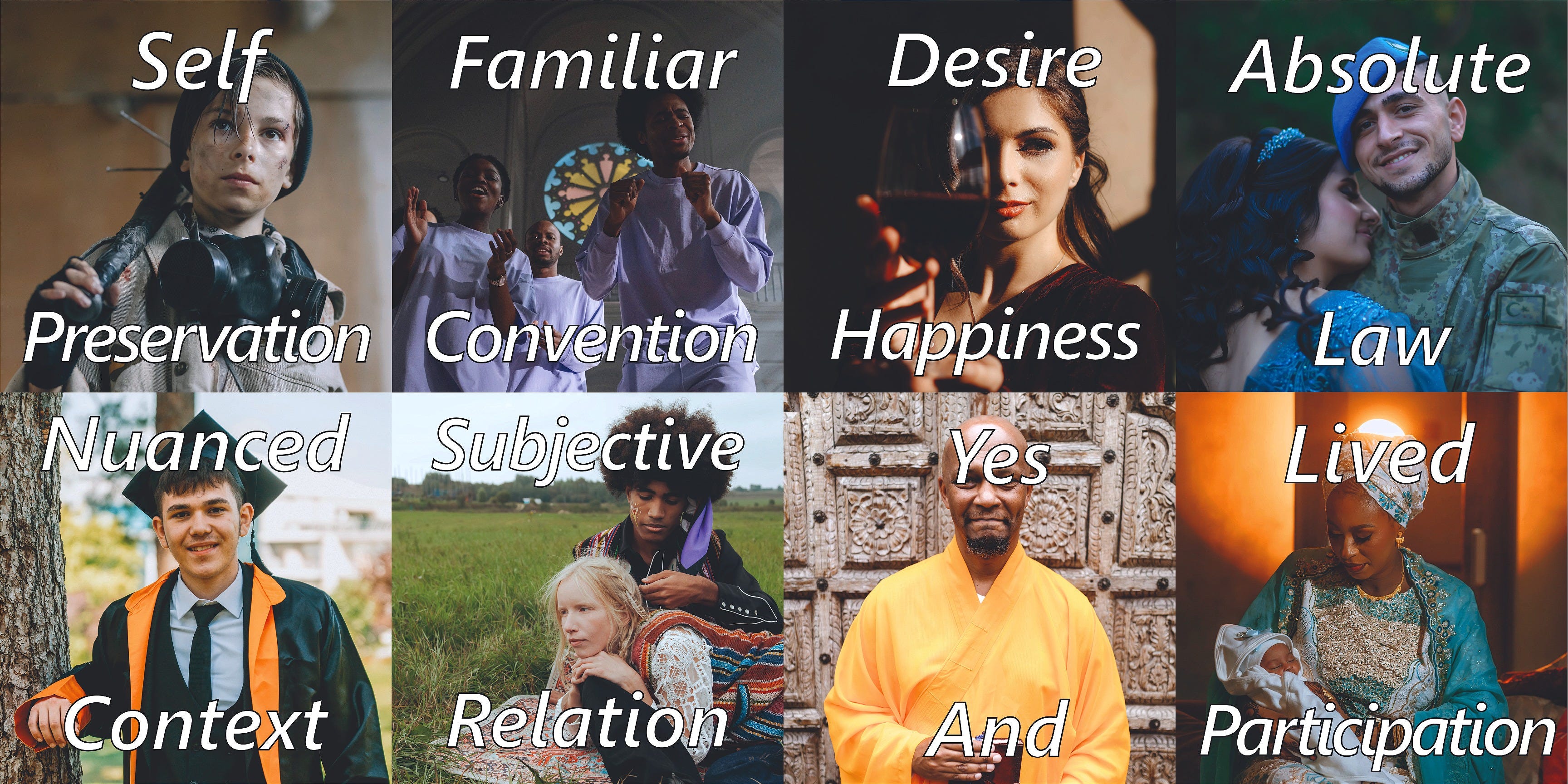
The Moral Reasonings of the Spiral
🤎Beige: Self-Preservation
💜Purple: Familiar-Convention
❤️Red: Desire-Happiness
💙Blue: Absolute-Law
🧡Orange: Nuanced-Context
💚Green: Subjective-Relation
💛Yellow: Yes-And
🩵Turquoise: Lived-Participation
As you can see, we are not talking about what values are focused upon through a certain color-lens (though the Spiral gives insight into that as well), but the reasoning as to why one thing should be done/prioritized (seen as good or moral) over another.
Disclaimer: As with all spiral dynamics conversations, it’s important to remember that just because the colors are organized according to a progressive development (and thus natural hierarchy), this does not mean there is any superiority or better-ness to later/higher colors… or for that matter to earlier/foundational colors. It is a core Spiral teaching is that no color is inherently better or worse than any other.
With that, let’s dive into the series!
Next article in series: 🤎Self-Preservation: The Foundation of Life
Photo Credits (I added text in Illustrator):
Photo by cottonbro studio on Pexels
Photo by cottonbro studio on Pexels
Photo by Natali Hordiiuk on Unsplash
Photo by mehmet dadük on Pexels
Photo by Kadir Altıntaş on Pexels
Photo by cottonbro studio on Pexels
Photo by RDNE Stock project on Pexels
Photo by Kaybee Photography on Pexels
This means morality/normativity straddles all the 4 kinds of knowing. Propositions can be normatively evaluated based on their accuracy, procedures based on their effectiveness, perspectives based on their quality of presence and appropriateness of affordances, and participation based on cultivation of belonging and fittedness.